

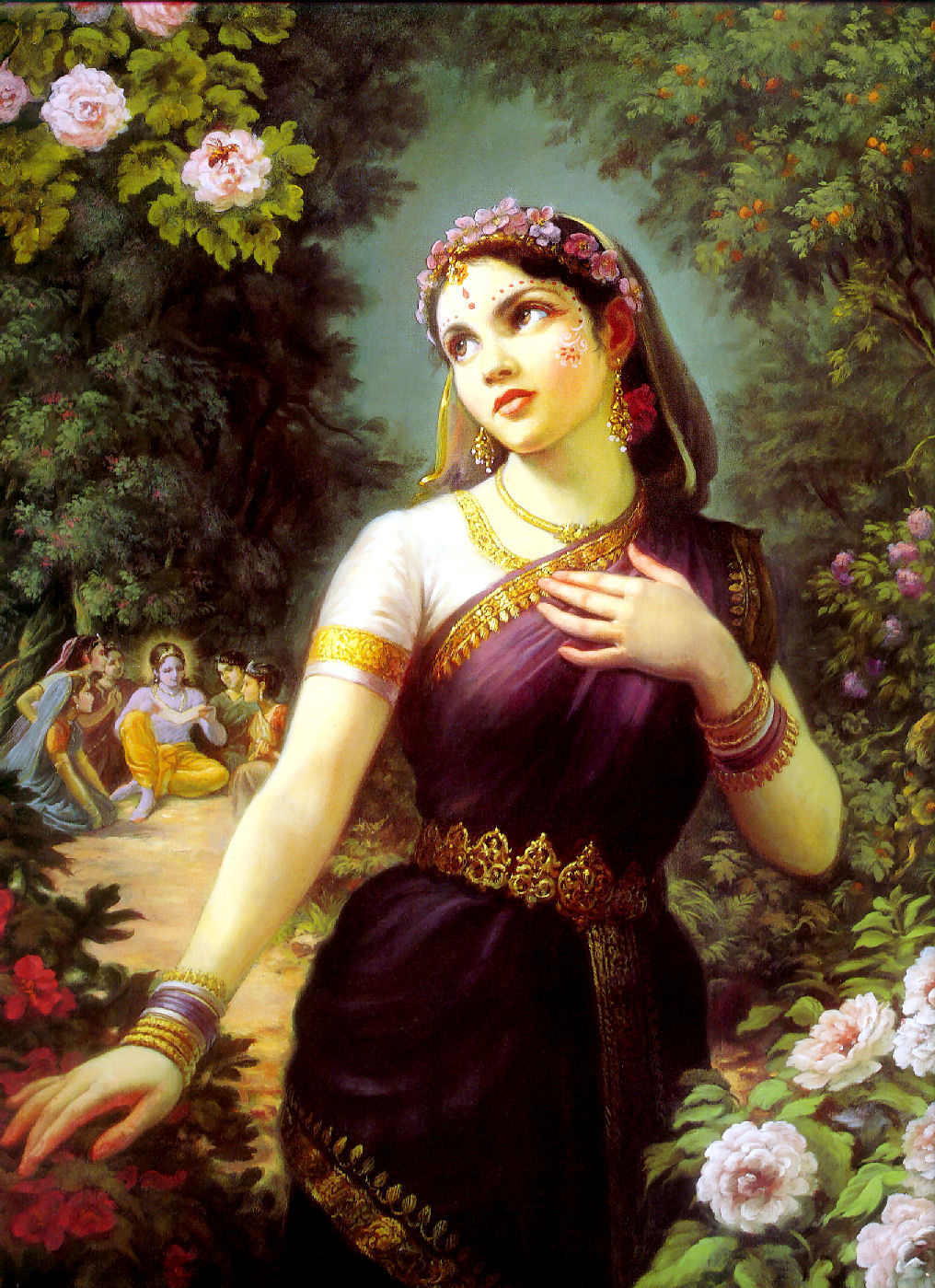


The Thousand Names of Śrī Rādhā
[From the Nārada-pañcarātra, translated by Bhaktivinoda Ṭhākura,
translated into English by Kuśakratha Prabhu]
Śrī Rādhā Sahasra-nāma was originally spoken by Lord Śiva
to Pārvati devi, recorded in the 5th Chapter of Śrī Nārada-pañcarātra.
Texts 1 and 2
श्री-पार्वत्य् उवाच
śrī-pārvaty uvāca
| deva-deva jagannātha bhaktānugraha-kāraka yady asti mayi kāruṇyaṁ mayi yady asti te dayā yad yat tvayā pragaditaṁ tat sarvaṁ me śrutaṁ prabho guhyād guhyataraṁ yat tu yat te manasi kāśite |
देव-देव जगन्नाथ भक्तानुग्रह-कारक यद्य् अस्ति मयि कारुण्यं मयि यद्य् अस्ति ते दया यद् यत् त्वया प्रगदितं तत् सर्वं मे श्रुतं प्रभो गुह्याद् गुह्यतरं यत् तु यत् ते मनसि काशिते |
Śrī Pārvatī said: O lord of lords, O master of the universe, O master kind to your devotees, if you are kind to me, if you have mercy for me, then, O lord, please tell me all you have heard, the most secret of secrets in your effulgent heart.
Texts 3 and 4
tvayā na gaditaṁ yat tu śrī-rādhāyā maha-devyā |
त्वया न गदितं यत् तु यस्मै कस्मै कदचन तन् मां कथय देवेश सहस्रं नाम चोत्तमम् श्री-राधाया मह-देव्या गोप्या भक्ति-प्रसाधनम् ब्रह्माण्ड-कर्त्री हर्त्री सा कथं गोपीत्वम् आगता |
O lord of lords, the transcendental thousand names of Goddess Śrī Rādhā-gopī, which inspire pure devotional service, and which you have never told anyone, please tell to me. Why is the Goddess, who creates and destroys the universes, a gopī?
Text 5
श्री-महादेव उवाच
śrī-mahādeva uvāca
| śṛṇu devi vicitrārthāṁ kathāṁ pāpa-harāṁ śubhām nāsti janmāṇi karmāṇi tasyā nūnaṁ maheśvari |
शृणु देवि विचित्रार्थां कथां पाप-हरां शुभाम् नास्ति जन्माणि कर्माणि तस्या नूनं महेश्वरि |
Lord Śiva said: O goddess, O queen, please hear this auspicious and very wonderful truth, which destroys sins: For Her their are neither births nor material activities.
Text 6
| yadā hariś caritrāṇi kurute kārya-gocarāt tadā vidhātṛ-rūpāṇi hari-sānnidhya-sādhinī |
यदा हरिश् चरित्राणि कुरुते कार्य-गोचरात् तदा विधातृ-रूपाणि हरि-सान्निध्य-साधिनी |
When Lord Hari, out of a sense of duty, performs activities (in the material world), she, desiring to be near Him, assumes many different forms.
Text 7
| tasyā gopītva-bhāvasya kāraṇaṁ gaditaṁ purā idānīṁ śṛṇu deveśi nāmnāṁ caiva sahasrakam |
तस्या गोपीत्व-भावस्य कारणं गदितं पुरा इदानीं शृणु देवेशि नाम्नां चैव सहस्रकम् |
I have already explained why She is a gopī. O goddess, now please hear Her thousand names.
Text 8
| yan mayā kathitaṁ naiva tantreṣv api kadāpi na tava snehāt pravakṣyāmi bhaktyā dhāryaṁ mumukṣubhiḥ |
यन् मया कथितं नैव तन्त्रेष्व् अपि कदापि न तव स्नेहात् प्रवक्ष्यामि भक्त्या धार्यं मुमुक्षुभिः |
What I have never spoken in the Tantras and what they who yearn for liberation cherish, out of love for you, I will now speak.
Text 9
| mama prāṇa-samā vidyā bhavyate me tv ahar-niśam śṛṇuṣva girije nityaṁ paṭhasva ca yathā-mati |
मम प्राण-समा विद्या भव्यते मे त्व् अहर्-निशम् शृणुष्व गिरिजे नित्यं पठस्व च यथा-मति |
Day and night this knowledge is as dear to me as life. O daughter of the mountain king, please hear and regularly chant (these thousand names) as far as you are able.
Text 10
| yasyāḥ prasādāt kṛṣṇas tu golokeśaḥ paraḥ prabhuḥ asyā nāma-sahasrasya ṛṣir nārada eva ca |
यस्याः प्रसादात् कृष्णस् तु गोलोकेशः परः प्रभुः अस्या नाम-सहस्रस्य ऋषिर् नारद एव च |
By Her kindness Kṛṣṇa, the master of Goloka, is the Supreme Master. Nārada is the sage of Her thousand holy names.
Text 11
devī rādhā parā proktā oṁ śrī-rādhā rādhikā kṛṣṇa- |
देवी राधा परा प्रोक्ता चतुर्-वर्ग-प्रसाधिनी ॐ श्री-राधा राधिका कृष्ण- वल्लभा कृष्ण-सम्युता |
Rādhā, who grants the four goals of life, is said to be the Supreme Goddess.
(Her thousand names follow.)
Om. She is Lord Kṛṣṇa's greatest worshiper (śrī-rādhā and rādhikā), Lord Kṛṣṇa's beloved (kṛṣṇa-vallabhā), and Lord Kṛṣṇa's constant companion (kṛṣṇa-samyutā).
Text 12
| vṛndāvaneśvarī kṛṣṇa- priyā madana-mohinī śrīmatī kṛṣṇa-kāntā ca kṛṣṇānanda-pradāyinī |
वृन्दावनेश्वरी कृष्ण- प्रिया मदन-मोहिनी श्रीमती कृष्ण-कान्ता च कृष्णानन्द-प्रदायिनी |
She is the queen of Vṛndāvana (vṛndāvaneśvarī), the beloved of Lord Kṛṣṇa (kṛṣṇa- priyā), more charming than Kāmadeva (madana-mohinī), beautiful (śrīmatī), Lord Kṛṣṇa's beloved (kṛṣṇa-kāntā), and the giver of bliss to Lord Kṛṣṇa (kṛṣṇānanda- pradāyinī).
Text 13
| yaśasvinī yaśogamyā yaśodānanana-vallabhā dāmodara-priyā gopī gopānanda-karī tathā |
यशस्विनी यशोगम्या यशोदाननन-वल्लभा दामोदर-प्रिया गोपी गोपानन्द-करी तथा |
She is famous (yaśasvinī and yaśogamyā), the beloved of Yaśodā's son (yaśodānanana-vallabhā), dear to Lord Dāmodara (dāmodara-priyā), a cowherd girl (gopī), and the giver of happiness to the gopas (gopānanda-karī).
Text 14
| kṛṣṇāṅga-vāsinī hṛdyā hari-kāntā hari-priyā pradhāna-gopikā gopa- kanyā trailokya-sundarī |
कृष्णाङ्ग-वासिनी हृद्या हरि-कान्ता हरि-प्रिया प्रधान-गोपिका गोप- कन्या त्रैलोक्य-सुन्दरी |
Her residence is on Lord Kṛṣṇa's limbs (kṛṣṇāṅga-vāsinī). She is charming (hṛdyā). She is Lord Hari's beloved (hari-kāntā and hari-priyā), the most important gopī (pradhāna-gopikā), the daughter of a gopa (gopa-kanyā), and the most beautiful girl in the three worlds (trailokya-sundarī).
Text 15
| vṛndāvana-vihārī ca vikaśita-mukhāmbujā gokulānanda-kartrī ca gokulānanda-dāyinī |
वृन्दावन-विहारी च विकशित-मुखाम्बुजा गोकुलानन्द-कर्त्री च गोकुलानन्द-दायिनी |
She enjoys pastimes in Vṛndāvana (vṛndāvana-vihārī), Her face is a blossoming lotus (vikaśita-mukhāmbujā), and she brings happiness to Gokula (gokulānanda-kartrī and gokulānanda-dāyinī).
Text 16
| gati-pradā gīta-gamyā gamanāgamana-priyā viṣṇu-priyā viṣṇu-kāntā viṣṇor aṅga-nivāsinī |
गति-प्रदा गीत-गम्या गमनागमन-प्रिया विष्णु-प्रिया विष्णु-कान्ता विष्णोर् अङ्ग-निवासिनी |
She gives the goal of life (gati-pradā), is approached by chanting her holy names (gīta- gamyā), is the beloved of the omniprescent Supreme Personality of Godhead (gamanāgamana-priyā), is Lord Viṣṇu's beloved (viṣṇu-priyā and viṣṇu-kāntā), and resides on Lord Viṣṇu's limbs (viṣṇor aṅga-nivāsinī).
Text 17
| yaśodānanda-patnī ca yaśodānanda-gehinī kāmāri-kāntā kāmeśī kāma-lālasa-vigrahā |
यशोदानन्द-पत्नी च यशोदानन्द-गेहिनी कामारि-कान्ता कामेशी काम-लालस-विग्रहा |
She is the wife of Yaśodā's son (yaśodānanda-patnī and yaśodānanda-gehinī), the beloved of lust's enemy (kāmāri-kāntā), Lord Kṛṣṇa's amorous queen (kāmeśī), and Lord Kṛṣṇa's passionate lover (kāma-lālasa-vigrahā).
Text 18
| jaya-pradā jayā jīvā jīvānanda-pradāyinī nandanandana-patnī ca vṛṣabhānu-sutā śivā |
जय-प्रदा जया जीवा जीवानन्द-प्रदायिनी नन्दनन्दन-पत्नी च वृषभानु-सुता शिवा |
She is the giver of victory (jaya-pradā) and She is victory itself (jayā). She is life (jīvā), the giver of happiness to the living entities (jīvānanda-pradāyinī), the wife of Nanda's son (nandanandana-patnī), King Vṛṣabhānu's daughter (vṛṣabhānu-sutā), and auspicious (śivā).
Text 19
| gaṇādhyakṣā gavādhyakṣā gavāṁ gatir anuttamā kāñcanābhā hema-gātrī kāñcanāṅgada-dhāriṇī |
गणाध्यक्षा गवाध्यक्षा गवां गतिर् अनुत्तमा काञ्चनाभा हेम-गात्री काञ्चनाङ्गद-धारिणी |
She is the leader of the gopīs (gaṇādhyakṣā), the ruler of the cows (gavādhyakṣā and gavāṁ gati), and without superior (anuttamā). She has a golden complexion (kāñcanābhā), Her limbs are golden (hema-gātrī), and She wears golden armlets (kāñcanāṅgada-dhāriṇī).
Text 20
| aśokā śokorahitā viśokā śoka-nāśinī gāyatrī vedamātā ca vedātīta vid-uttamā |
अशोका शोकोरहिता विशोका शोक-नाशिनी गायत्री वेदमाता च वेदातीत विद्-उत्तमा |
She never laments (aśokā, śokorahitā, and viśokā), she ends lamentation (śoka-nāśinī). She is the Gāaytrī mantra (gāyatrī), the mother of the Vedas (veda-mātā), beyond the Vedas (vedātīta), and the wiseset philosopher (vid-uttamā).
Text 21
| nīti-śāstra-priyā nīti- gatir matir abhīṣṭadā veda-priyā veda-garbhā veda-mārga-pravardhinī |
नीति-शास्त्र-प्रिया नीति- गतिर् मतिर् अभीष्टदा वेद-प्रिया वेद-गर्भा वेद-मार्ग-प्रवर्धिनी |
She is an eager student of the scriptures describing ethics (nīti-śāstra-priyā). She is the perfect moralist (nīti-gati), the most thoughtful philosopher (mati), the fulfiller of desires (abhīṣṭadā), an eager student of the Vedas (veda-priyā), the mother of the Vedas (veda-garbhā), and the teacher of the Vedas' path (veda-mārga-pravardhinī).
Text 22
| veda-gamyā veda-parā vicitra-kanakojjvalā tathojjvala-pradā nityā tathaivojjvala-gātrikā |
वेद-गम्या वेद-परा विचित्र-कनकोज्ज्वला तथोज्ज्वल-प्रदा नित्या तथैवोज्ज्वल-गात्रिका |
She is approached by Vedic study (veda-gamyā). She is the supreme goal described in the Vedas (veda-parā). She is splendid with wonderful golden ornaments (vicitra- kanakojjvalā), glorious (ujjvala-pradā), and eternal (nityā), and Her limbs are filled with glory (ujjvala-gātrikā).
Text 23
| nanda-priyā nanda-sutā- radhyānandapradā śubhā śubhāṅgī vimalāṅgī ca vilasiny aparājitā |
नन्द-प्रिया नन्द-सुता- रध्यानन्दप्रदा शुभा शुभाङ्गी विमलाङ्गी च विलसिन्य् अपराजिता |
She is dear to Mahārāja Nanda (nanda-priyā), worshiped by Nanda's son (nanda- sutārādhyā), delightful (ānanda-pradā), beautiful (śubhā), with beautiful limbs (śubhāṅgī), with splendid limbs (vimalāṅgī), playful (vilasinī), and unconquerable (aparājitā).
Text 24
| jananī janmaśūnyā ca janma-mṛtyu-jarāpahā gatir gatimatām dhātrī dhātrānandapradāyinī |
जननी जन्मशून्या च जन्म-मृत्यु-जरापहा गतिर् गतिमताम् धात्री धात्रानन्दप्रदायिनी |
She is the mother of all (jananī), without birth (janma-śūnyā), the remover of birth, death, and old-age (janma-mṛtyu-jarāpahā), the supreme goal of the aspiring devotees (gatir gatimatām), the mother of all (dhātrī), and the giver of bliss to the Supreme Creator (dhātrānanda-pradāyinī).
Text 25
| jagannātha-priyā śaila- vāsinī hema-sundarī kiśorī kamalā padmā padma-hastā payoda-dā |
जगन्नाथ-प्रिया शैल- वासिनी हेम-सुन्दरी किशोरी कमला पद्मा पद्म-हस्ता पयोद-दा |
She is dear to the Lord of the universes (jagannātha-priyā), She resides on a hill (śaila- vāsinī), is beautiful and golden (hema-sundarī), is youthful (kiśorī), like a lotus flower (kamalā and padmā), her hands are lotuses (padma-hastā), and She is buxom (payoda- dā).
Text 26
| payasvinī payo-dātrī pavitrā sarva-maṅgalā mahā-jīva-pradā kṛṣṇa- kāntā kamala-sundarī |
पयस्विनी पयो-दात्री पवित्रा सर्व-मङ्गला महा-जीव-प्रदा कृष्ण- कान्ता कमल-सुन्दरी |
She is buxom (payasvinī and payo-dātrī), pure (pavitrā), all-auspicious (sarva- maṅgalā), the great giver of life (mahā-jīva-pradā), Lord Kṛṣṇa's beloved (kṛṣṇa- kāntā), and beautiful as a lotus (kamala-sundarī).
Text 27
| vicitra-vāsinī citra- vāsinī citra-rūpiṇī nirguṇā su-kulīnā ca niṣkulīnā nirākulā |
विचित्र-वासिनी चित्र- वासिनी चित्र-रूपिणी निर्गुणा सु-कुलीना च निष्कुलीना निराकुला |
She is wonderfully fragrant (vicitra-vāsinī and citra-vāsinī), wonderfully beautiful (citra-rūpiṇī), free of the modes of material nature (nirguṇā), born in a pious family (su-kulīnā), not born in any family of the material world (niṣkulīnā), and free from all distrees (nirākulā).
Text 28
| gokulāntara-gehā ca yogānanda-karī tathā veṇu-vādyā veṇu-ratiḥ veṇu-vādya-parāyaṇā |
गोकुलान्तर-गेहा च योगानन्द-करी तथा वेणु-वाद्या वेणु-रतिः वेणु-वाद्य-परायणा |
Her home is in Gokula (gokulāntara-gehā). She delights Lord Kṛṣṇa when She meets Him (yogānanda-karī). She plays the flute (veṇu-vādyā), enjoys playing the flute (veṇu-rati), and is fond of playing the flute (veṇu-vādya-parāyaṇā).
Text 29
| gopālasya priyā saumya- rūpā saumya-kulodvahā mohāmohā vimohā ca gati-niṣṭhā gati-pradā |
गोपालस्य प्रिया सौम्य- रूपा सौम्य-कुलोद्वहा मोहामोहा विमोहा च गति-निष्ठा गति-प्रदा |
She is Lord Gopāla's beloved (gopālasya priyā). She is gentle and noble (saumya- rūpā), born in an exalted family (saumya-kulodvahā), charming (mohā and vimohā), and free from bewilderment (amohā), and She gives the goal of life (gati-niṣṭhā and gati-pradā).
Text 30
| gīrbāṇa-vandyā girbāṇā girbāṇa-gaṇa-sevitā lalitā ca viśokā ca viśākhā citra-mālinī |
गीर्बाण-वन्द्या गिर्बाणा गिर्बाण-गण-सेविता ललिता च विशोका च विशाखा चित्र-मालिनी |
The demigods offer repsectful obeisances to Her (gīrbāṇa-vandyā). She is divine (girbāṇā), served by the demigods (girbāṇa-gaṇa-sevitā), playful and charming (lalitā), free from lamentation (viśokā), the star Viśākhā (viśākhā), and decorated with wonderful garlands (citra-mālinī).
Text 31
| jitendriyā śuddha-sattvā kulīnā kula-dīpikā dīpa-priyā dīpa-dātrī vimalā vimalodakā |
जितेन्द्रिया शुद्ध-सत्त्वा कुलीना कुल-दीपिका दीप-प्रिया दीप-दात्री विमला विमलोदका |
She has conquered Her senses (jitendriyā). She is situated in pure goodness (śuddha- sattvā), born in a noble family (kulīnā), the lamp illuminating Her family (kula- dīpikā), fond of lamps (dīpa-priyā), the giver of the lamp (dīpa-dātrī), pure (vimalā), and the sacred river (vimalodakā).
Text 32
| kāntāra-vāsinī kṛṣṇā kṛṣṇacandra-priyā matiḥ anuttarā duḥkha-hantrī duḥkha-kartrī kulodvahā |
कान्तार-वासिनी कृष्णा कृष्णचन्द्र-प्रिया मतिः अनुत्तरा दुःख-हन्त्री दुःख-कर्त्री कुलोद्वहा |
She lives in a forest (kāntāra-vāsinī). She is Lord Kṛṣṇa's beloved (kṛṣṇā and kṛṣṇacandra-priyā). She is thoughtfulness (mati), unsurpassed (anuttarā), the remover of sufferings (duḥkha-hantrī), the creator of sufferings (duḥkha-kartrī), and the noblest in Her family (kulodvahā).
Text 33
| matir lakṣmīr dhṛtir lajjā kāntiḥ puṣṭiḥ smṛtiḥ kṣamā kṣīrodaśāyinī devī devāri-kula-mardinī |
मतिर् लक्ष्मीर् धृतिर् लज्जा कान्तिः पुष्टिः स्मृतिः क्षमा क्षीरोदशायिनी देवी देवारि-कुल-मर्दिनी |
She is thoughtfulness (mati), Goddess Lakṣmī (lakṣmī), perseverance (dhṛti), modesty (lajjā), beauty (kānti), fulfillment (puṣṭi), memory (smṛti), patience (kṣamā), she who lies down on the ocean of milk (kṣīrodaśāyinī), the goddess (devī), and the crusher of Lord Kṛṣṇa's enemies (devāri-kula-mardinī).
Text 34
| vaiṣṇavī ca mahā-lakṣmīḥ kula-pūjyā kula-priyā samhartrī sarva-daityānāṁ sāvitrī veda-gāminī |
वैष्णवी च महा-लक्ष्मीः कुल-पूज्या कुल-प्रिया सम्हर्त्री सर्व-दैत्यानां सावित्री वेद-गामिनी |
She is Lord Viṣṇu's consort (vaiṣṇavī), Goddess Mahā-Lakṣmī (mahā-lakṣmī), worshiped by Her family (kula-pūjyā), dear to Her family (kula-priyā), the destroyer of all the demons (samhartrī sarva-daityānāṁ), the gāyatrī mantra (sāvitrī), and a follower of the Vedas (veda-gāminī).
Text 35
| vedātītā nirālambā nirālamba-gaṇa-priyā nirālamba-janaiḥ pūjyā nirālokā nirāśrayā |
वेदातीता निरालम्बा निरालम्ब-गण-प्रिया निरालम्ब-जनैः पूज्या निरालोका निराश्रया |
She is beyond the Vedas (vedātītā), liberated (nirālambā), dear to the liberated (nirālamba-gaṇa-priyā), worshiped by the liberated (nirālamba-janaiḥ pūjyā), unseen by conditioned souls (nirālokā), and independent (nirāśrayā).
Text 36
| ekāṅgā sarvagā sevyā brahma-patnī sarasvatī rāsa-priyā rāsa-gamyā rāsādhiṣṭhātṛ-devatā |
एकाङ्गा सर्वगा सेव्या ब्रह्म-पत्नी सरस्वती रास-प्रिया रास-गम्या रासाधिष्ठातृ-देवता |
She has one form (ekāṅgā). She is all-pervading (sarvagā), the supreme object of worship (sevyā), Brahmā's wife (brahma-patnī), Goddess Sarasvatī (sarasvatī), fond of the rāsa dance (rāsa-priyā), the girl Lord Kṛṣṇa approaches in the rāsa dance (rāsa- gamyā), and the predominating Deity of the rāsa dance (rāsādhiṣṭhātṛ-devatā).
Text 37
| rasikā rasikānandā svayam rāseśvarī parā rāsa-maṇḍala-madhyasthā rāsa-maṇḍala-śobhitā |
रसिका रसिकानन्दा स्वयम् रासेश्वरी परा रास-मण्डल-मध्यस्था रास-मण्डल-शोभिता |
She enjoys the transcendental mellows (rasikā) and tastes the bliss of the transcendental mellows (rasikānandā). She is the queen of the rāsa dance (svayam rāseśvarī), transcendental (parā), the girl who stays in the middle of the rāsa dance circle (rāsa-maṇḍala-madhyasthā), and the girl who beautifies the rāsa dance circle (rāsa-maṇḍala-śobhitā).
Text 38
| rāsa-maṇḍala-sevyā ca rāsa-krīḍā manoharā puṇḍarīkākṣa-nilayā puṇḍarīkākṣa-gehinī |
रास-मण्डल-सेव्या च रास-क्रीडा मनोहरा पुण्डरीकाक्ष-निलया पुण्डरीकाक्ष-गेहिनी |
She is served in the rāsa dance circle (rāsa-maṇḍala-sevyā), and She enjoys the pastime of the rāsa dance (rāsa-krīḍā). She is beautiful (manoharā), Her dark eyes are lotus flowers (puṇḍarīkākṣa-nilayā), and She is the wife of lotus-eyed Kṛṣṇa (puṇḍarīkākṣa-gehinī).
Text 39
| puṇḍarīkākṣa-sevyā ca puṇḍarīkākṣa-vallabhā sarva-jīveśvarī sarva- jīva-vandyā parāt parā |
पुण्डरीकाक्ष-सेव्या च पुण्डरीकाक्ष-वल्लभा सर्व-जीवेश्वरी सर्व- जीव-वन्द्या परात् परा |
She is served by lotus-eyed Kṛṣṇa (puṇḍarīkākṣa-sevyā), dear to lotus-eyed Kṛṣṇa (puṇḍarīkākṣa-vallabhā), the queen of all living entities (sarva-jīveśvarī), worshiped by all living entities (sarva-jīva-vandyā), and greater than the greatest (parāt parā).
Text 40
| prakṛtiḥ śambhu-kāntā ca sadāśiva-manoharā kṣut pipāsā dayā nidrā bhrāntiḥ śrāntiḥ kṣamākulā |
प्रकृतिः शम्भु-कान्ता च सदाशिव-मनोहरा क्षुत् पिपासा दया निद्रा भ्रान्तिः श्रान्तिः क्षमाकुला |
She is the goddess of the material nature (prakṛti), and the lover of the all attractive Kṛṣṇa or Viṣṇu (śambhu-kāntā and sadāśiva-manoharā). She is hunger (kṣut), thirst (pipāsā), mercy (dayā), sleep (nidrā), bewilderment (bhrānti), exhaustion (śrānti), and patience (kṣamākulā).
Please Note: although GENERALLY Śambhu is referring to Lord Śiva, but in this particular verse-translation it refers to the “All-Attractive One” (manoharā), who causes happiness to his devotees (śambhu). In the Viṣṇu-Sahasranāma Śambhu is another name of Viṣṇu.
Text 41
| vadhū-rūpā gopa-patnī bhāratī siddha-yogīnī satya-rūpā nitya-rūpā nityāṅgī nitya-gehinī |
वधू-रूपा गोप-पत्नी भारती सिद्ध-योगीनी सत्य-रूपा नित्य-रूपा नित्याङ्गी नित्य-गेहिनी |
She is a young girl (vadhū-rūpā), the wife of a gopa (gopa-patnī), the goddess of eloquence (bhāratī), and perfect in the science of yoga (siddha-yogīnī). Her form is eternal (satya-rūpā, nitya-rūpā, and nityāṅgī), and She is Lord Kṛṣṇa's wife eternally (nitya-gehinī).
Text 42
| sthāna-dātrī tathā dhātrī mahā-lakṣmīḥ svayam-prabhā sindhu-kanyā sthāna-dātrī dvārakā-vāsinī tathā |
स्थान-दात्री तथा धात्री महा-लक्ष्मीः स्वयम्-प्रभा सिन्धु-कन्या स्थान-दात्री द्वारका-वासिनी तथा |
She gives Her devotees their homes (sthāna-dātrī). She is the mother (dhātrī), Goddess Mahā-Lakṣmī (mahā-lakṣmī), self-effulgent (svayam-prabhā), the daughter of the milk ocean (sindhu-kanyā), and she who resides in Dvārakā (dvārakā-vāsinī).
Text 43
| buddhiḥ sthitiḥ sthāna-rūpā sarva-kāraṇa-kāraṇā bhakti-priyā bhakti-gamyā bhaktānanda-pradāyinī |
बुद्धिः स्थितिः स्थान-रूपा सर्व-कारण-कारणा भक्ति-प्रिया भक्ति-गम्या भक्तानन्द-प्रदायिनी |
She is intelligence (buddhi), steadiness (sthiti and sthāna-rūpā), the cause of all causes (sarva-kāraṇa-kāraṇā), fond of serving Lord Kṛṣṇa (bhakti-priyā), approached by devotional service (bhakti-gamyā), and the giver of bliss to the devotees (bhaktānanda-pradāyinī).
Text 44
| bhakta-kalpa-drumātītā tathātīta-guṇā tathā mano-'dhiṣṭhātṛ-devī ca kṛṣṇa-prema-parāyaṇā |
भक्त-कल्प-द्रुमातीता तथातीत-गुणा तथा मनो-ऽधिष्ठातृ-देवी च कृष्ण-प्रेम-परायणा |
She is more than a kalpa-vṛkṣa tree for the devotees (bhakta-kalpa-drumātītā), the possessor of the greatest transcendental virtues (atīta-guṇā), the predominating Deity of the heart (mano-'dhiṣṭhātṛ-devī), and the girl completely in love with Lord Kṛṣṇa (kṛṣṇa-prema-parāyaṇā).
Text 45
| nirāmayā saumya-dātrī tathā madana-mohinī ekānaṁśā śivā kṣemā durgā durgati-nāśinī |
निरामया सौम्य-दात्री तथा मदन-मोहिनी एकानंशा शिवा क्षेमा दुर्गा दुर्गति-नाशिनी |
She is free from all disease (nirāmayā), the most gentle, kind, and generous (saumya- dātrī), more charming than Kāmadeva (madana-mohinī), one without a second (ekā and anaṁśā), the wife of Lord Śiva (śivā and durgā), happiness and auspiciousness personified (kṣemā), and the person who destroys all calamities (durgati-nāśinī).
Text 46
| īśvarī sarva-vandyā ca gopanīyā śubhaṅkarī pālinī sarva-bhūtānāṁ tathā kāmāṅga-hāriṇī |
ईश्वरी सर्व-वन्द्या च गोपनीया शुभङ्करी पालिनी सर्व-भूतानां तथा कामाङ्ग-हारिणी |
She is the supreme controller (īśvarī), worshiped by all (sarva-vandyā), reclusive (gopanīyā), the giver of auspiciousness (śubhaṅkarī), the protectress of all living entities (pālinī sarva-bhūtānām), and the wife of Lord Śiva who destroyed Kāmadeva's body (kāmāṅga-hāriṇī).
Text 47
| sadyo-mukti-pradā devī veda-sārā parāt parā himālaya-sutā sarvā pārvatī girijā satī |
सद्यो-मुक्ति-प्रदा देवी वेद-सारा परात् परा हिमालय-सुता सर्वा पार्वती गिरिजा सती |
She is the person who quickly gives liberation (sadyo-mukti-pradā), the goddess (devī), the essence of the Vedas (veda-sārā), greater than the greatest (parāt parā), and Goddess Pārvatī (himālaya-sutā, sarvā, pārvatī, girijā, and satī).
Text 48
| dakṣa-kanyā deva-mātā manda-lajjā hares tanuḥ vṛndāraṇya-priyā vṛndā vṛndāvana-vilāsinī |
दक्ष-कन्या देव-माता मन्द-लज्जा हरेस् तनुः वृन्दारण्य-प्रिया वृन्दा वृन्दावन-विलासिनी |
She is Dakṣa's daughter (dakṣa-kanyā), the demigods' mother (deva-mātā), bold (manda-lajjā), Lord Hari's own transcendental form (hares tanuḥ), fond of Vṛndāvana (vṛndāraṇya-priyā), goddess Vṛndā (vṛndā), and the girl who enjoys pastimes in Vṛndāvana (vṛndāvana-vilāsinī).
Text 49
| vilāsinī vaiṣṇavī ca brahmaloka-pratiṣṭhitā rukmiṇī revatī satya- bhāmā jāmbavatī tathā |
विलासिनी वैष्णवी च ब्रह्मलोक-प्रतिष्ठिता रुक्मिणी रेवती सत्य- भामा जाम्बवती तथा |
She is playful (vilāsinī), Lord Viṣṇu's companion (vaiṣṇavī), the predominating goddess of the spiritual world (brahmaloka-pratiṣṭhitā), Rukmiṇī (rukmiṇī), Revatī (revatī), Satyabhāmā (satyabhāmā), and Jāmbavatī (jāmbavatī).
Text 50
| sulakṣmaṇā mitravindā kālindī jahnu-kanykā paripūrṇā pūrṇatarā tathā haimavatī gatiḥ |
सुलक्ष्मणा मित्रविन्दा कालिन्दी जह्नु-कन्य्का परिपूर्णा पूर्णतरा तथा हैमवती गतिः |
She is Sulakṣmaṇā (sulakṣmaṇā), Mitravindā (mitravindā), Kālindī (kālindī), Jāhnavī (jahnu-kanykā), most perfect (paripūrṇā and pūrṇatarā), Goddess Pārvatī (haimavatī), and the supreme goal of life (gati).
Text 51
| apūrvā brahma-rūpā ca brahmāṇḍa-paripālinī brahmāṇḍa-bhāṇḍa-madbyasthā brahmāṇḍa-bhāṇḍa-rūpiṇī |
अपूर्वा ब्रह्म-रूपा च ब्रह्माण्ड-परिपालिनी ब्रह्माण्ड-भाण्ड-मद्ब्यस्था ब्रह्माण्ड-भाण्ड-रूपिणी |
She is unprecedented (apūrvā), spiritual (brahma-rūpā), the protectress of the universe (brahmāṇḍa-paripālinī), the goddess who enters the material universe (brahmāṇḍa-
bhāṇḍa-madbyasthā), the goddess who Herself is the material universe (brahmāṇḍa- bhāṇḍa-rūpiṇī).
Text 52
| aṇḍa-rūpāṇḍa-madhyasthā tathāṇḍa-paripālinī aṇḍa-bāhyāṇḍa-samhartrī śiva-brahma-hari-priyā |
अण्ड-रूपाण्ड-मध्यस्था तथाण्ड-परिपालिनी अण्ड-बाह्याण्ड-सम्हर्त्री शिव-ब्रह्म-हरि-प्रिया |
She is the goddess who is the material universe (aṇḍa-rūpā), the goddess who has entered the material universe (aṇḍa-madhyasthā), the protectress of the material universe (aṇḍa-paripālinī), the goddess who is beyond the material universe (aṇḍa- bāhyā), the destroyer of the material universe (aṇḍa-samhartrī), and she who is dear to Śiva, Brahmā, and Viṣṇu (śiva-brahma-hari-priyā).
Text 53
| mahā-viṣṇu-priyā kalpa-vṛkṣa-rūpā nirantarā sāra-bhūtā sthirā gaurī gaurāṅgī śaśi-śekharā |
महा-विष्णु-प्रिया कल्प-वृक्ष-रूपा निरन्तरा सार-भूता स्थिरा गौरी गौराङ्गी शशि-शेखरा |
She is Lord Mahā-Viṣṇu's beloved (mahā-viṣṇu-priyā), a kalpa-vṛkṣa tree (kalpa- vṛkṣa-rūpā), eternal (nirantarā and sthirā), the best (sāra-bhūtā), fair (gaurī and gaurāṅgī), and Lord Śiva's wife (śaśi-śekharā).
Text 54
| śveta-campaka-varṇābhā śaśi-koṭi-sama-prabhā mālatī-mālya-bhūṣāḍhyā mālatī-mālya-dhāriṇī |
श्वेत-चम्पक-वर्णाभा शशि-कोटि-सम-प्रभा मालती-माल्य-भूषाढ्या मालती-माल्य-धारिणी |
She is fair as a śveta campaka flower (śveta-campaka-varṇābhā), splendid as millions of moons (śaśi-koṭi-sama-prabhā), and decorated with jasmine garlands (mālatī- mālya-bhūṣāḍhyā and mālatī-mālya-dhāriṇī).
Text 55
| kṛṣṇa-stutā kṛṣṇa-kāntā vṛndāvana-vilāsinī tulasy-adhiṣṭhātṛ-devī saṁsārārṇava-pāra-dā |
कृष्ण-स्तुता कृष्ण-कान्ता वृन्दावन-विलासिनी तुलस्य्-अधिष्ठातृ-देवी संसारार्णव-पार-दा |
She is praised by Kṛṣṇa (kṛṣṇa-stutā) and loved by Kṛṣṇa (kṛṣṇa-kāntā). She enjoys pastimes in Vṛndāvana (vṛndāvana-vilāsinī). She is Goddess Tulasī (tulasy-adhiṣṭhātṛ-devī). She carries one to the farther shore of the ocean of birth and death (saṁsārārṇava-pāra-dā).
Text 56
| sāradāhāradāmbhodā yasodā gopa-nandinī atīta-gamanā gaurī parānugraha-kāriṇī |
सारदाहारदाम्भोदा यसोदा गोप-नन्दिनी अतीत-गमना गौरी परानुग्रह-कारिणी |
She gives what is the best (sāradā). She gives food (āhāradā). She gives water (ambhodā). She gives fame (yaśodā). She is a gopa's daughter (gopa-nandinī), very graceful (atīta-gamanā), fair (gaurī), and kind to others (parānugraha-kāriṇī).
Text 57
| karuṇārṇava-sampurṇā karuṇārṇava-dhāriṇī mādhavī mādhava-mano- hāriṇī śyāma-vallabhā |
करुणार्णव-सम्पुर्णा करुणार्णव-धारिणी माधवी माधव-मनो- हारिणी श्याम-वल्लभा |
She is a flooding ocean of mercy (karuṇārṇava-sampurṇā and karuṇārṇava-dhāriṇī). She is Lord Kṛṣṇa's beloved (mādhavī and śyāma-vallabhā), and she charms Lord Kṛṣṇa's heart (mādhava-mano-hāriṇī).
Text 58
| andhakāra-bhaya-dhvastā maṅgalyā maṅgala-pradā śrī-garbhā śrī-pradā śrīśā śrī-nivāsācyutapriyā |
अन्धकार-भय-ध्वस्ता मङ्गल्या मङ्गल-प्रदा श्री-गर्भा श्री-प्रदा श्रीशा श्री-निवासाच्युतप्रिया |
She removes the fear of darkness (andhakāra-bhaya-dhvastā). She is auspicious (maṅgalyā), the giver of auspiciousness (maṅgala-pradā), the mother of all beauty (śrī- garbhā), the giver of beauty (śrī-pradā), the queen of beauty (śrīśā), the abode of beauty (śrī-nivāsā), and the beloved of the infallible Supreme Personality of Godhead (acyutapriyā).
Text 59
| śrī-rūpā śrī-harā śrīdā śrī-kāmā śrī-svarūpiṇī śrīdāmānanda-dātrī ca śrīdāmeśvara-vallabhā |
श्री-रूपा श्री-हरा श्रीदा श्री-कामा श्री-स्वरूपिणी श्रीदामानन्द-दात्री च श्रीदामेश्वर-वल्लभा |
She is the form of beauty (śrī-rūpā and śrī-svarūpiṇī), the remover of beauty (śrī-harā), the giver of beauty (śrīdā), the desire for beauty (śrī-kāmā), the giver of bliss to Śrīdāmā (śrīdāmānanda-dātrī), and dear to Śrīdāmā's master (śrīdāmeśvara-vallabhā).
Text 60
| śrī-nitambā śrī-gaṇeśā śrī-svarūpāśritā śrutiḥ śrī-kriyā-rūpiṇī śrīlā śrī-kṛṣṇa-bhajanānvitā |
श्री-नितम्बा श्री-गणेशा श्री-स्वरूपाश्रिता श्रुतिः श्री-क्रिया-रूपिणी श्रीला श्री-कृष्ण-भजनान्विता |
She has beautiful hips (śrī-nitambā). She is the beautiful queen of the gopīs (śrī- gaṇeśā). She is beautiful (śrī-svarūpāśritā and śrīlā). She is the Vedas (śruti) and the activities of devotional service (śrī-kriyā-rūpiṇī). She devotedly worships Śrī Kṛṣṇa (śrī-kṛṣṇa-bhajanānvitā).
Text 61
| śrī-rādhā śrīmatī śreṣṭhā śreṣṭha-rūpā śruti-priyā yogeśā yoga-mātā ca yogātitā yuga-priyā |
श्री-राधा श्रीमती श्रेष्ठा श्रेष्ठ-रूपा श्रुति-प्रिया योगेशा योग-माता च योगातिता युग-प्रिया |
She worships Lord Kṛṣṇa (śrī-rādhā). She is beautiful (śrīmatī). She is the best (śreṣṭhā and śreṣṭha-rūpā). She is dear to the Vedas (śruti-priyā), the queen of yoga (yogeśā), the mother of yoga (yoga-mātā), beyond yoga (yogātitā), and dear to the two divine persons (yuga-priyā).
Text 62
| yoga-priyā yoga-gamyā yoginī-gaṇa-vanditā javā-kusuma-saṅkāsā dāḍ_imī-kusumopamā |
योग-प्रिया योग-गम्या योगिनी-गण-वन्दिता जवा-कुसुम-सङ्कासा दाड्इमी-कुसुमोपमा |
She is dear to yoga (yoga-priyā), approached by yoga (yoga-gamyā), worshiped by the yoginīs (yoginī-gaṇa-vanditā), glorious as a rose (javā-kusuma-saṅkāsā), and glorious as a pomegranate (dāḍ_imī-kusumopamā).
Text 63
| nīlāmbaradharā dhīrā dhairya-rūpa-dharā dhṛitiḥ ratna-siṁhāsana-sthā ca ratna-kuṇḍala-bhūṣitā |
नीलाम्बरधरा धीरा धैर्य-रूप-धरा धृइतिः रत्न-सिंहासन-स्था च रत्न-कुण्डल-भूषिता |
She wears blue garments (nīlāmbara-dharā). She is very sober and serious (dhīrā and dhairya-rūpa-dharā). She is seriousness (dhṛiti). She sits on a jewel throne (ratna- siṁhāsana-sthā) and She is decorated with jewel earrings (ratna-kuṇḍala-bhūṣitā).
Text 64
| ratnālaṅkāra-samyuktā ratna-mālya-dharā parā ratnendra-sāra-hārāḍhyā ratna-mālā-vibhūṣitā |
रत्नालङ्कार-सम्युक्ता रत्न-माल्य-धरा परा रत्नेन्द्र-सार-हाराढ्या रत्न-माला-विभूषिता |
She wears jewel ornaments (ratnālaṅkāra-samyuktā), a necklace of jewels (ratna- mālya-dharā and ratna-mālā-vibhūṣitā), and a necklace of the kings of jewels (ratnendra-sāra-hārāḍhyā). She is transcendental (parā).
Text 65
| indranīla-maṇi-nyasta- pāda-padma-śubhā śuciḥ kārttikī paurṇamāsī ca amāvasyā bhayāpahā |
इन्द्रनील-मणि-न्यस्त- पाद-पद्म-शुभा शुचिः कार्त्तिकी पौर्णमासी च अमावस्या भयापहा |
Her lotus feet are beautiful with sapphire ornaments (indranīla-maṇi-nyasta-pāda- padma-śubhā) and She is beautiful (śuci). She is the month of Kārttika (kārttikī), the full-moon day (paurṇamāsī), the new-moon day (amāvasyā), and the remover of fears (bhayāpahā).
Text 66
| govinda-rāja-gṛhinī govinda-gaṇa-pūjitā vaikuṇṭha-nātha-gṛhiṇī vaikuṇṭha-paramālayā |
गोविन्द-राज-गृहिनी गोविन्द-गण-पूजिता वैकुण्ठ-नाथ-गृहिणी वैकुण्ठ-परमालया |
She is Lord Govinda's queen (govinda-rāja-gṛhinī) and She is worshiped by Lord Govinda's devotees (govinda-gaṇa-pūjitā). She is the queen of Vaikuṇṭha's king (vaikuṇṭha-nātha-gṛhiṇī) and She resides in the supreme abode of Vaikuṇṭha (vaikuṇṭha-paramālayā).
Text 67
| vaikuṇṭhadeva-devāḍhyā tathā vaikuṇṭha-sundarī mahālasā vedavatī sītā sādhvī pati-vratā |
वैकुण्ठदेव-देवाढ्या तथा वैकुण्ठ-सुन्दरी महालसा वेदवती सीता साध्वी पति-व्रता |
She is glorious in the comopany of Vaikuṇṭha's supreme king (vaikuṇṭha-deva- devāḍhyā) and She is the beautiful goddess of Vaikuṇṭha (vaikuṇṭha-sundarī). She is languid (mahālasā), wise (vedavatī), saintly (sādhvī), and devoted to Her Lord (pati- vratā). She is Goddess Sītā (sītā).
Text 68
| anna-pūrṇā sadānanda- rūpā kaivalya-sundarī kaivalya-dāyinī śreṣṭhā gopīnātha-manoharā |
अन्न-पूर्णा सदानन्द- रूपा कैवल्य-सुन्दरी कैवल्य-दायिनी श्रेष्ठा गोपीनाथ-मनोहरा |
She is Goddess Durgā (anna-pūrṇā). Her form is full of eternal bliss (sadānanda-rūpā). She is the most beautiful (kaivalya-sundarī), the giver of liberation (kaivalya-dāyinī), the best (śreṣṭhā), and the girl who charms Lord Gopīnātha's heart (gopīnātha- manoharā).
Text 69
| gopīnātheśvarī caṇḍī nāyikā-nayanānvitā nāyikā nāyaka-prītā nāyakānanda-rūpiṇī |
गोपीनाथेश्वरी चण्डी नायिका-नयनान्विता नायिका नायक-प्रीता नायकानन्द-रूपिणी |
She is Lord Gopīnātha's queen (gopīnātheśvarī). She is passionate (caṇḍī). She has the eyes of a beautiful heroine (nāyikā-nayanānvitā). She is a beautiful heroine (nāyikā). She is dear to the hero Kṛṣṇa (nāyaka-prītā). She delights the hero Kṛṣṇa (nāyakānanda-rūpiṇī).
Text 70
| śeṣā śeṣavatī śeṣa- rūpiṇī jagad-ambikā gopāla-pālikā māyā jāyānandapradā tathā |
शेषा शेषवती शेष- रूपिणी जगद्-अम्बिका गोपाल-पालिका माया जायानन्दप्रदा तथा |
She reclines on Lord Śeṣa (śeṣā, śeṣavatī, and śeṣa-rūpiṇī). She is the mother of the universe (jagad-ambikā), the protectress of the cowherd people (gopāla-pālikā), the Lord's illusory potency (māyā), and she who gives the bliss of victory (jāyānandapradā).
Text 71
| kumārī yauvanānandā yuvatī gopa-sundarī gopa-mātā jānakī ca janakānanda-kāriṇī |
कुमारी यौवनानन्दा युवती गोप-सुन्दरी गोप-माता जानकी च जनकानन्द-कारिणी |
She is a young girl (kumārī and yuvatī), filled with the bliss of youthfulness (yauvanānandā), a beautiful gopī (gopa-sundarī), the mother of the gopas (gopa-mātā), the daughter of King Janaka (jānakī), and the girl who gives bliss to King Janaka (janakānanda-kāriṇī).
Text 72
| kailāsa-vāsinī rambhā vairāgyākula-dīpikā kamalā-kānta-gṛhinī kamalā kamalālayā |
कैलास-वासिनी रम्भा वैराग्याकुल-दीपिका कमला-कान्त-गृहिनी कमला कमलालया |
She is the Goddess who resides on Mount Kailāsa (kailāsa-vāsinī). She is the apsarā Rambhā (rambhā). She is a glowing lamp of renunciation (vairāgyākula-dīpikā). She is Lord Nārāyaṇa's wife (kamalā-kānta-gṛhinī). She is the goddess of fortune (kamalā) and the abode where the goddess of fortune resides (kamalālayā).
Text 73
| trailokya-mātā jagatām adhiṣṭhātrī priyāmbikā hara-kāntā hara-ratā harānanda-pradāyinī |
त्रैलोक्य-माता जगताम् अधिष्ठात्री प्रियाम्बिका हर-कान्ता हर-रता हरानन्द-प्रदायिनी |
She is the mother of the three worlds (trailokya-mātā), the predominating Deity of the universes (jagatām adhiṣṭhātrī), the beloved (priyā), the mother (ambikā), the beloved of Lord Śiva (hara-kāntā and hara-ratā), and She who gives bliss to Lord Śiva (harānanda-pradāyinī).
Text 74
| hara-patnī hara-prīta hara-tośaṇa-tatparā hareśvarī rāma-ratā rāmā rāmeśvarī ramā |
हर-पत्नी हर-प्रीत हर-तोशण-तत्परा हरेश्वरी राम-रता रामा रामेश्वरी रमा |
She is Lord Śiva's wife (hara-patnī), Lord Śiva's beloved (hara-prītā), devoted to pleasing Lord Śiva (hara-tośaṇa-tatparā), Lord Śiva's queen (hareśvarī), Lord Rāma's beloved (rāma-ratā and rāmā), and Lord Rāma's queen (rāmeśvarī).
Text 75
| śyāmalā citra-lekhā ca tathā bhuvana-mohinī su-gopī gopa-vanitā gopa-rājya-pradā śubhā |
श्यामला चित्र-लेखा च तथा भुवन-मोहिनी सु-गोपी गोप-वनिता गोप-राज्य-प्रदा शुभा |
She is Lord Kṛṣṇa's beloved (śyāmalā), wonderfully beautiful (citra-lekhā), the enchantress of the three worlds (bhuvana-mohinī), a beautiful gopī (su-gopī and gopa- vanitā), she who gives a kingdom to the gopas (gopa-rājya-pradā), and beautiful (śubhā).
Text 76
| aṅgāvapūrṇā māheyī matsya-rāja-sutā satī kaumārī nārasiṁhī ca vārāhī nava-durgikā |
अङ्गावपूर्णा माहेयी मत्स्य-राज-सुता सती कौमारी नारसिंही च वाराही नव-दुर्गिका |
She is beautiful (aṅgāvapūrṇā), the queen of the earth (māheyī), the daughter of Matsyarāja (matsya-rāja-sutā), saintly (satī), a young girl (kaumārī), Lord Nṛsiṁha's beloved goddess of fortune (nārasiṁhī), Lord Varāha's beloved (vārāhī), and the mother of the nine Durgās (nava-durgikā).
Text 77
| cañcalā cañcalāmodā nārī bhuvana-sundarī dakṣa-yajña-harā dākṣī dakṣa-kanyā su-locanā |
चञ्चला चञ्चलामोदा नारी भुवन-सुन्दरी दक्ष-यज्ञ-हरा दाक्षी दक्ष-कन्या सु-लोचना |
She is fickle (cañcalā and cañcalāmodā), appears to be a human girl (nārī), is the most beautiful girl in the worlds (bhuvana-sundarī), stopped Dakṣa's yajña (dakṣa-yajña- harā), is Dakṣa's daughter (dākṣī and dakṣa-kanyā), and has beautiful eyes (su-locanā).
Text 78
| rati-rūpā rati-prītā rati-śreṣṭhā rati-pradā ratir lakṣmaṇa-geha-sthā virajā bhuvaneśvarī |
रति-रूपा रति-प्रीता रति-श्रेष्ठा रति-प्रदा रतिर् लक्ष्मण-गेह-स्था विरजा भुवनेश्वरी |
She is beautiful (rati-rūpā), delightful (rati-prītā and rati-pradā), the most delightful (rati-śreṣṭhā) happiness (rati), the goddess who stays in Lakṣmaṇa's home (lakṣmaṇa- geha-sthā), free from the world of matter (virajā), and the queen who rules the worlds (bhuvaneśvarī).
Text 79
| śaṅkhāspadā harer jāyā jāmātṛ-kula-vanditā bakulā bakulāmoda- dhāriṇī yamunā jayā |
शङ्खास्पदा हरेर् जाया जामातृ-कुल-वन्दिता बकुला बकुलामोद- धारिणी यमुना जया |
She has countless transcendental abodes (śaṅkhāspadā). She is Lord Hari's wife (harer jāyā). She is worshiped by Her in-laws (jāmātṛ-kula-vanditā). She is beautiful as a bakula flower (bakulā) and fragrant as a bakula flower (bakulāmoda-dhāriṇī). She is the Yamunā river (yamunā) and the goddess of victory (jayā).
Text 80
| vijayā jaya-patnī ca yamalārjuna-bhañjinī vakreśvarī vakra-rūpā vakra-vīkṣaṇa-vīkṣitā |
विजया जय-पत्नी च यमलार्जुन-भञ्जिनी वक्रेश्वरी वक्र-रूपा वक्र-वीक्षण-वीक्षिता |
She is the goddess of victory (vijayā), the wife of the Lord of victory (jaya-patnī), the beloved of He who broke the yamalārjuna trees (yamalārjuna-bhañjinī), the queen of the crooked and deceptive (vakreśvarī), graceful (vakra-rūpā), and a girl expert at crooked glances (vakra-vīkṣaṇa-vīkṣitā).
Text 81
| aparājitā jagannāthā jagannātheśvarī yatiḥ khecarī khecara-sutā khecaratva-pradāyinī |
अपराजिता जगन्नाथा जगन्नाथेश्वरी यतिः खेचरी खेचर-सुता खेचरत्व-प्रदायिनी |
She is unconquerable (aparājitā), the queen of the universes (jagannāthā), she who controls the king of the universes (jagannātheśvarī), renounced (yati), a goddess who lives in the celestial worlds (khecarī khecara-sutā), and one who brings others to the celestial worlds (khecaratva-pradāyinī).
Text 82
| viṣṇu-vakṣaḥ-sthala-sthā ca viṣṇu-bhāvana-tatparā candra-koṭi-sugātrī ca candrānana-manoharī |
विष्णु-वक्षः-स्थल-स्था च विष्णु-भावन-तत्परा चन्द्र-कोटि-सुगात्री च चन्द्रानन-मनोहरी |
She rests on Lord Viṣṇu's chest (viṣṇu-vakṣaḥ-sthala-sthā) and is rapt in meditation on Lord Viṣṇu (viṣṇu-bhāvana-tatparā). She is beautiful as millions of moons (candra- koṭi-sugātrī) and Her moonlike face is very beautiful (candrānana-manoharī).
Text 83
| sevā-sevyā śivā kṣemā tathā kṣema-kārī vadhūḥ yādavendra-vadhūḥ sevyā śiva-bhaktā śivānvitā |
सेवा-सेव्या शिवा क्षेमा तथा क्षेम-कारी वधूः यादवेन्द्र-वधूः सेव्या शिव-भक्ता शिवान्विता |
She should be served with devotion (sevā-sevyā). She is Lord Śiva's beloved (śivā). She is patience (kṣemā), patient (kṣema-kārī), a beautiful girl (vadhū), the wife of the Yādavas' king (yādavendra-vadhū), the object of devotional service (sevyā), a great devotee of Lord Śiva (śiva-bhaktā), and Lord Śiva's companion (śivānvitā).
Text 84
| kevalā niṣphalā sūkṣmā mahā-bhīmābhayapradā jīmūta-rūpā jaimūtī jitāmitra-pramodinī |
केवला निष्फला सूक्ष्मा महा-भीमाभयप्रदा जीमूत-रूपा जैमूती जितामित्र-प्रमोदिनी |
She is liberated (kevalā), free from the fruits of karma (niṣphalā), subtle (sūkṣmā), terrifying (mahā-bhīmā), the giver of fearlessness (abhayapradā), the sustainer (jīmūta-rūpā), Lord Viṣṇu's beloved (jaimūtī), and the girl who delights Lord Viṣṇu (jitāmitra-pramodinī).
Text 85
| gopāla-vanitā nandā kulajendra-nivāsinī jayantī yamunāṅgī ca yamunā-toṣa-kārinī |
गोपाल-वनिता नन्दा कुलजेन्द्र-निवासिनी जयन्ती यमुनाङ्गी च यमुना-तोष-कारिनी |
She is Lord Gopāla's beloved (gopāla-vanitā), dear to King Nanda (nandā), of noble birth (kulajā), the resident of a king's palace (indra-nivāsinī), glorious (jayantī), a girl who stays by the Yamunā (yamunāṅgī), and a girl who pleases the Yamunā (yamunā- toṣa-kārinī).
Text 86
| kali-kalmaṣa-bhaṅgā ca kali-kalmaṣa-nāśinī kali-kalmaṣa-rūpā ca nityānanda-karī kṛpā |
कलि-कल्मष-भङ्गा च कलि-कल्मष-नाशिनी कलि-कल्मष-रूपा च नित्यानन्द-करी कृपा |
She breaks and destroys the sins of Kali-yuga (kali-kalmaṣa-bhaṅgā and kali-kalmaṣa- nāśinī). She is expert at enjoying pastimes of quarreling with Lord Kṛṣṇa (kali- kalmaṣa-rūpā). She brings Lord Kṛṣṇa eternal bliss (nityānanda-karī). She is kindness personified (kṛpā).
Text 87
| kṛpāvatī kulavatī kailāsācala-vāsinī vāma-devī vāma-bhāgā govinda-priya-kāriṇī |
कृपावती कुलवती कैलासाचल-वासिनी वाम-देवी वाम-भागा गोविन्द-प्रिय-कारिणी |
She is merciful (kṛpāvatī), born in a very respectable and noble family (kulavatī), the goddess who resides on Mount Kailāsa (kailāsācala-vāsinī), beautiful (vāma-devī and vāma-bhāgā), and she who delights Lord Govinda (govinda-priya-kāriṇī).
Text 88
| nagendra-kanyā yogeśī yoginī yoga-rūpiṇī yoga-siddhā siddha-rūpā siddha-kṣetra-nivāsinī |
नगेन्द्र-कन्या योगेशी योगिनी योग-रूपिणी योग-सिद्धा सिद्ध-रूपा सिद्ध-क्षेत्र-निवासिनी |
She is the daughter of Nāgarāja (nagendra-kanyā), the queen of yoga (yogeśī) a performer of yoga (yoginī), yoga personified (yoga-rūpiṇī), the perfection of yoga (yoga-siddhā), the perfection of yoga personified (siddha-rūpā), and she who resides in a sacred place (siddha-kṣetra-nivāsinī).
Text 89
| kṣetrādhiṣṭhātṛ-rūpā ca kṣetrātītā kula-pradā keśavānanda-dātrī ca keśavānanda-dāyinī |
क्षेत्राधिष्ठातृ-रूपा च क्षेत्रातीता कुल-प्रदा केशवानन्द-दात्री च केशवानन्द-दायिनी |
She is the predominating Deity of sacred places (kṣetrādhiṣṭhātṛ-rūpā), beyond all places in this world (kṣetrātītā), born in a noble family (kula-pradā), and the giver of happiness to Lord Keśava (keśavānanda-dātrī and keśavānanda-dāyinī).
Text 90
| keśavā keśava-prītā keśavī keśava-priyā rāsa-krīḍā-karī rāsa- vāsinī rāsa-sundarī |
केशवा केशव-प्रीता केशवी केशव-प्रिया रास-क्रीडा-करी रास- वासिनी रास-सुन्दरी |
She is Lord Keśava's beloved (keśavā, keśava-prītā, keśavī, and keśava-priyā), the enjoyer of the rāsa-dance pastimes (rāsa-krīḍā-karī), the girl who stays in the rāsa- dance arena (rāsa- vāsinī), and the beautiful girl of the rāasa dance (rāsa-sundarī).
Text 91
| gokulānvita-dehā ca gokulatva-pradāyinī lavaṅga-nāmnī nāraṅgī nāraṅga-kula-maṇḍanā |
गोकुलान्वित-देहा च गोकुलत्व-प्रदायिनी लवङ्ग-नाम्नी नारङ्गी नारङ्ग-कुल-मण्डना |
She stays in Gokula (gokulānvita-dehā), gives residence in Gokula to others (gokulatva-pradāyinī), has a name beautiful as a a lavaṅgha flower (lavaṅga-nāmnī), is amorous (nāraṅgī), and is the transcendental decoration of amorous Kṛṣṇa (nāraṅga- kula-maṇḍanā).
Text 92
| elā-lavaṅga-karpūra- mukha-vāsa-mukhānvitā mukhyā mukhya-pradā mukhya- rūpā mukhya-nivāsinī |
एला-लवङ्ग-कर्पूर- मुख-वास-मुखान्विता मुख्या मुख्य-प्रदा मुख्य- रूपा मुख्य-निवासिनी |
She is anointed with elā, lavaṅga, karpūra and many other fragrances (elā-lavaṅga- karpūra-mukha-vāsa-mukhānvitā), is the most exalted of young girls (mukhyā), gives the most valuable thing (mukhya-pradā), has the most beautiful form (mukhya-rūpā), and lives in the best abode (mukhya-nivāsinī).
Text 93
| nārāyaṇī kripātītā karuṇāmaya-kāriṇī kāruṇyā karuṇā karṇā gokarṇā nāga-karṇikā |
नारायणी क्रिपातीता करुणामय-कारिणी कारुण्या करुणा कर्णा गोकर्णा नाग-कर्णिका |
She is Lord Nārāyaṇa's beloved (nārāyaṇī). She is supremely merciful (kṛpātītā, karuṇāmaya-kāriṇī, kāruṇyā, and karuṇā). She is the sacred place Gokarṇa (gokarṇā), Karṇa (karṇā), and Nāga-karṇikā (nāga-karṇikā).
Text 94
| sarpiṇī kaulinī kṣetra- vāsinī jagad-anvayā jaṭilā kuṭilā nīlā nīlāmbaradharā śubhā |
सर्पिणी कौलिनी क्षेत्र- वासिनी जगद्-अन्वया जटिला कुटिला नीला नीलाम्बरधरा शुभा |
She is graceful (sarpiṇī), born in a noble family (kaulinī), a resident of holy places (kṣetra-vāsinī), the mother of the universes (jagad-anvayā), an ascetic (jaṭilā), crooked (kuṭilā), beauitful (nīlā and śubhā), and dressed in blue garments (nīlāmbaradharā).
Text 95
| nīlāmbara-vidhātrī ca nīlakaṇṭha-priyā tathā bhaginī bhāginī bhogyā kṛṣṇa-bhogyā bhageśvarī |
नीलाम्बर-विधात्री च नीलकण्ठ-प्रिया तथा भगिनी भागिनी भोग्या कृष्ण-भोग्या भगेश्वरी |
She is dressed in blue garments (nīlāmbara-vidhātrī). She is Lord Śiva's beloved (nīlakaṇṭha-priyā). She is beautiful (bhaginī, bhāginī, and bhogyā), Lord Kṛṣṇa's happiness (kṛṣṇa-bhogyā), and the queen of transcendental opulences (bhageśvarī).
Text 96
| baleśvarī balārādhyā kāntā kānta-nitambinī nitambinī rūpavatī yuvatī kṛṣṇa-pīvarī |
बलेश्वरी बलाराध्या कान्ता कान्त-नितम्बिनी नितम्बिनी रूपवती युवती कृष्ण-पीवरी |
She is Lord Balarāma's queen (baleśvarī), worshiped by Lord Balarāma (balārādhyā), beautiful (kāntā and rūpavatī), a girl with beautiful hips (kānta-nitambinī nitambinī), youthful (yuvatī), and Lord Kṛṣṇa's beloved (kṛṣṇa-pīvarī).
Text 97
| vibhāvarī vetravatī saṅkaṭā kuṭilālakā nārāyaṇa-priyā śalilā sṛkkaṇī-parimohitā |
विभावरी वेत्रवती सङ्कटा कुटिलालका नारायण-प्रिया शलिला सृक्कणी-परिमोहिता |
She is amorous (vibhāvarī). She holds a stick (vetravatī). She is slender (saṅkaṭā). Her hair is curly (kuṭilālakā). She is Lord Nārāyaṇa's beloved (nārāyaṇa-priyā). She resides on a hill (śalilā). With the movements of Her mouth She ecnhants Lord Kṛṣṇa (sṛkkaṇī-parimohitā).
Text 98
| dṛk-pāta-mohitā prātar- āśinī navanītikā navīnā nava-nārī ca nāraṅga-phala-śobhitā |
दृक्-पात-मोहिता प्रातर्- आशिनी नवनीतिका नवीना नव-नारी च नारङ्ग-फल-शोभिता |
With a glance She enchants Lord Kṛṣṇa (dṛk-pāta-mohitā). She eats breakfast early (prātar-āśinī) and churns butter (navanītikā). She is young (navīnā nava-nārī), and she is splendid as a nāraṅga fruit (ca nāraṅga-phala-śobhitā).
Text 99
| haimī hema-mukhī candra- mukhī śaśi-su-śobhanā ardha-candra-dharā candra- vallabhā rohiṇī tamiḥ |
हैमी हेम-मुखी चन्द्र- मुखी शशि-सु-शोभना अर्ध-चन्द्र-धरा चन्द्र- वल्लभा रोहिणी तमिः |
She is splendid as gold (haimī). Her face is golden (hema-mukhī). Her face is like the moon (candra-mukhī). She is beautiful as the moon (śaśi-su-śobhanā), like a graceful half-moon (ardha-candra-dharā), dear to moonlike Kṛṣṇa (candra-vallabhā), a beautiful young girl (rohiṇī), and splendid as the night (tami).
Text 100
| timiṅgla-kulāmoda- matsya-rūpāṅga-hāriṇī kāraṇī sarva-bhūtānāṁ kāryātītā kiśoriṇī |
तिमिङ्ग्ल-कुलामोद- मत्स्य-रूपाङ्ग-हारिणी कारणी सर्व-भूतानां कार्यातीता किशोरिणी |
She became the beloved of Lord Matsya and delighted the timiṅgilas (timiṅgla- kulāmoda-matsya-rūpāṅga-hāriṇī). She is the mother of all living entities (kāraṇī sarva-bhūtānāṁ). She is beyond all material duties (kāryātītā). She is a beautiful young girl (kiśoriṇī).
Text 101
| kiśora-vallabhā keśa- kārikā kāma-kārikā kāmeśvarī kāma-kalā kālindī-kūla-dīpikā |
किशोर-वल्लभा केश- कारिका काम-कारिका कामेश्वरी काम-कला कालिन्दी-कूल-दीपिका |
She is youthful Kṛṣṇa's beloved (kiśora-vallabhā). She has beautiful hair (keśa- kārikā). She is passionate (kāma-kārikā), the queen of amorous pastimes (kāmeśvarī), expert at amorous pastimes (kāma-kalā), and the lamp that splendidly shines on the Yamunā's shore (kālindī-kūla-dīpikā).
Text 102
| kalindatanayā-tīra- vāsinī tīra-gehinī kādambarī-pāna-parā kusumāmoda-dhāriṇī |
कलिन्दतनया-तीर- वासिनी तीर-गेहिनी कादम्बरी-पान-परा कुसुमामोद-धारिणी |
She has made Her home on the Yamunā's shore (kalindatanayā-tīra-vāsinī and tīra- gehinī). She is fond of drinking kādambarī nectar (kādambarī-pāna-parā). She is fragrant with many flowers (kusumāmoda-dhāriṇī).
Text 103
| kumudā kumudānandā kṛṣṇeśī kāma-vallabhā tarkālī vaijayantī ca nimba-dāḍima-rūpiṇī |
कुमुदा कुमुदानन्दा कृष्णेशी काम-वल्लभा तर्काली वैजयन्ती च निम्ब-दाडिम-रूपिणी |
She is like a kumuda flower (kumudā). She is pleased by the kumuda flowers (kumudānandā). She is Lord Kṛṣṇa's queen (kṛṣṇeśī) and passionate lover (kāma- vallabhā). She is an expert logician (tarkālī). She is glorious (vaijayantī). Her form is like a nimba or a pomegranate tree (nimba-dāḍima-rūpiṇī).
Text 104
| bilva-vṛkṣa-priyā kṛṣṇām- barā bilvopama-stanī bilvātmikā bilva-vapur bilva-vṛkṣa-nivāsinī |
बिल्व-वृक्ष-प्रिया कृष्णाम्- बरा बिल्वोपम-स्तनी बिल्वात्मिका बिल्व-वपुर् बिल्व-वृक्ष-निवासिनी |
She is fond of the bilva tree (bilva-vṛkṣa-priyā). She is Lord Kṛṣṇa's garment (kṛṣṇāmbarā). Her breasts are like bilva fruits (bilvopama-stanī). Her form is like a bilva tree (bilvātmikā and bilva-vapuḥ). She stays under a bilva tree (bilva-vṛkṣa- nivāsinī).
Text 105
| tulasī-toṣikā taiti- lānanda-paritoṣikā gaja-muktā mahā-muktā mahā-mukti-phala-pradā |
तुलसी-तोषिका तैति- लानन्द-परितोषिका गज-मुक्ता महा-मुक्ता महा-मुक्ति-फल-प्रदा |
She pleases tulasī (tulasī-toṣikā). She pleases Taitilānanda (taitilānanda-paritoṣikā). She is decorated with gaja pearls (gaja-muktā, mahā-muktā, and mahā-mukti-phala- pradā).
Text 106
| anaṅga-mohinī śakti- rūpā śakti-svarūpinī pañca-śakti-svarūpā ca śaiśavānanda-kārinī |
अनङ्ग-मोहिनी शक्ति- रूपा शक्ति-स्वरूपिनी पञ्च-शक्ति-स्वरूपा च शैशवानन्द-कारिनी |
She is is charming and passionate (anaṅga-mohinī). She is Lord Kṛṣṇa's transcendental potency (śakti-rūpā and śakti-svarūpinī). She is the personification of five transcendental potencies (pañca-śakti-svarūpā). She is filled with the happiness of youth (śaiśavānanda-kārinī).
Text 107
| gajendra-gāminī śyāma- latānaṅga-latā tathā yoṣit-śakti-svarūpā ca yoṣid-ānanda-kāriṇī |
गजेन्द्र-गामिनी श्याम- लतानङ्ग-लता तथा योषित्-शक्ति-स्वरूपा च योषिद्-आनन्द-कारिणी |
She is graceful as an elephant (gajendra-gāminī). She is a flowering vine of beauty (śyāma-latā) and a flowering vine of passionate desires (anaṅga-latā). She is the personification of feminine power (yoṣit-śakti-svarūpā) and feminine bliss (yoṣid- ānanda-kāriṇī).
Text 108
| prema-priyā prema-rūpā premānanda-taraṅgiṇī prema-hārā prema-dātrī prema-śaktimayī tathā |
प्रेम-प्रिया प्रेम-रूपा प्रेमानन्द-तरङ्गिणी प्रेम-हारा प्रेम-दात्री प्रेम-शक्तिमयी तथा |
She passionately loves Lord Kṛṣṇa (prema-priyā). She is the form of all transcendental love (prema-rūpā). She is an ocean filled with waves of transcendental love (premānanda-taraṅgiṇī). She is the giver of transcendental love (prema-hārā and prema-dātrī). She is full of the power of transcendental love (prema-śaktimayī).
Text 109
| kṛṣṇa-premavatī dhanyā kṛṣṇa-prema-taraṅgiṇī prema-bhakti-pradā premā premānanda-taraṅgiṇī |
कृष्ण-प्रेमवती धन्या कृष्ण-प्रेम-तरङ्गिणी प्रेम-भक्ति-प्रदा प्रेमा प्रेमानन्द-तरङ्गिणी |
She loves Lord Kṛṣṇa (kṛṣṇa-premavatī). She is fortunate (dhanyā). She is an ocean filled with waves of love for Lord Kṛṣṇa (kṛṣṇa-prema-taraṅgiṇī). She gives loving devotional service (prema-bhakti-pradā). She is transcendental love (premā). She is an ocean filled with waves of the bliss of transcendental love (premānanda-taraṅgiṇī).
Text 110
| prema-krīḍā-parītāṅgī prema-bhakti-taraṅgiṇī premārtha-dāyiṇī sarva- śvetā nitya-taraṅgiṇī |
प्रेम-क्रीडा-परीताङ्गी प्रेम-भक्ति-तरङ्गिणी प्रेमार्थ-दायिणी सर्व- श्वेता नित्य-तरङ्गिणी |
Her limbs are filled with amorous playfulness (prema-krīḍā-parītāṅgī). She is an ocean filled with waves of loving devotional service (prema-bhakti-taraṅgiṇī). She gives a great wealth of transcendental love (premārtha-dāyiṇī). She is fair (sarvaśvetā), and She is an ocean of eternity (nitya-taraṅgiṇī).
Text 111
| hāva-bhāvānvitā raudrā rudrānanda-prakāśinī kapilā śṛṅkhalā keśa- pāśa-sambandhinī ghaṭī |
हाव-भावान्विता रौद्रा रुद्रानन्द-प्रकाशिनी कपिला शृङ्खला केश- पाश-सम्बन्धिनी घटी |
She is expert at flirting with Lord Kṛṣṇa (hāva-bhāvānvitā). She is Lord Śiva's beloved (raudrā). She delights Lord Śiva (rudrānanda-prakāśinī). She is fair (kapilā). She is the shackle that binds Lord Kṛṣṇa (śṛṅkhalā). She carefully braids Her hair (keśa-pāśa- sambandhinī). She carries a jug (ghaṭī).
Text 112
| kuṭīra-vāsinī dhūmrā dhūmra-keśā jalodarī brahmāṇḍa-gocarā brahma- rūpiṇī bhāva-bhāvinī |
कुटीर-वासिनी धूम्रा धूम्र-केशा जलोदरी ब्रह्माण्ड-गोचरा ब्रह्म- रूपिणी भाव-भाविनी |
She lives in a cottage (kuṭīra-vāsinī). She is Goddess Durgā (dhūmrā). Her hair is dark as smoke (dhūmra-keśā). She resides in the milk-ocean (jalodarī). She has descended to the material world (brahmāṇḍa-gocarā). Her form is spiritual (brahma-rūpiṇī). She is full of transcendental love (bhāva-bhāvinī).
Text 113
| saṁsāra-nāśinī śaivā śaivalānanda-dāyinī śiśirā hema-rāgāḍbyā megha-rūpāti-sundarī |
संसार-नाशिनी शैवा शैवलानन्द-दायिनी शिशिरा हेम-रागाड्ब्या मेघ-रूपाति-सुन्दरी |
She destroys the cycle of repeated birth and death (saṁsāra-nāśinī). She is Lord Śiva's beloved (śaivā). She bears the pleasing fragrance of śaivala (śaivalānanda-dāyinī). She is pleasantly cool (śiśirā), Her complexion is golden (hema-rāgāḍbyā), Her form is glorious as a cloud (megha-rūpā), and She is very beautiful (ati-sundarī).
Text 114
| manoramā vegavatī vegāḍhyā veda-vādinī dayānvitā dayādhārā dayā-rūpā susevinī |
मनोरमा वेगवती वेगाढ्या वेद-वादिनी दयान्विता दयाधारा दया-रूपा सुसेविनी |
She is beautiful (manoramā), quick (vegavatī and vegāḍhyā), eloquent in speaking the Vedas (veda-vādinī), merciful (dayānvitā, dayādhārā, and dayā-rūpā), and the proper object of devotional service (susevinī).
Text 115
| kiśora-saṅga-samsargā gaura-candrānanā kalā kalādhinātha-vadanā kalānāthādhirohiṇī |
किशोर-सङ्ग-सम्सर्गा गौर-चन्द्रानना कला कलाधिनाथ-वदना कलानाथाधिरोहिणी |
She meets youthful Kṛṣṇa (kiśora-saṅga-samsargā), Her face is a brilliant moon (gaura-candrānanā), She is a crescent moon (kalā), Her face is a full moon (kalādhinātha-vadanā), and She is glorious as a full moon (kalānāthādhirohiṇī).
Text 116
| virāga-kuśalā hema- piṅgalā hema-maṇḍanā bhāṇḍīra-tālavana-gā kaivartī pīvarī śukī |
विराग-कुशला हेम- पिङ्गला हेम-मण्डना भाण्डीर-तालवन-गा कैवर्ती पीवरी शुकी |
She is renounced (virāga-kuśalā), Her complexion is golden (hema-piṅgalā), She is decorated with golden ornaments (hema-maṇḍanā), She goes to Bhāṇḍīravana and Tālavana (bhāṇḍīra-tālavana-gā), She catches the fish that is Śrī Kṛṣṇa (kaivartī), She is a beautiful young girl (pīvarī), and She is graceful (śukī).
Text 117
| śukadeva-guṇātītā śukadeva-priyā sakhī vikalotkarṣiṇī koṣā kauṣeyāmbara-dhāriṇī |
शुकदेव-गुणातीता शुकदेव-प्रिया सखी विकलोत्कर्षिणी कोषा कौषेयाम्बर-धारिणी |
Her virtues are beyond the power of Śukadeva Gosvāmī to describe (śukadeva- guṇātītā), She is dear to Śukadeva Gosvāmī (śukadeva-priyā), She is friendly (sakhī), She picks up the fallen and unhappy (vikalotkarṣiṇī), She is a treasure-house of transcendental opulences (koṣā), and She is dressed in elegant silk garments (kauṣeyāmbara-dhāriṇī).
Text 118
| koṣāvarī koṣa-rūpā jagad-utpatti-kārikā sṛṣṭi-sthiti-karī saṁhā- riṇī saṁhāra-kāriṇī |
कोषावरी कोष-रूपा जगद्-उत्पत्ति-कारिका सृष्टि-स्थिति-करी संहा- रिणी संहार-कारिणी |
She is a treasure-house of transcendental opulences (koṣāvarī and koṣa-rūpā), the mother of the universes (jagad-utpatti-kārikā), the creature and maintainer of the universes (sṛṣṭi-sthiti-karī), and the destroyer of the universes (saṁhāriṇī and saṁhāra- kāriṇī).
Text 119
| keśa-śaivala-dhātrī ca candra-gātrī su-komalā padmāṅgarāga-samrāgā vindhyādri-parivāsiṇī |
केश-शैवल-धात्री च चन्द्र-गात्री सु-कोमला पद्माङ्गराग-सम्रागा विन्ध्याद्रि-परिवासिणी |
Her hair is dark moss (keśa-śaivala-dhātrī), and Her limbs are moons (candra-gātrī). She is very gentle and delicate (su-komalā), She is anointed with lotus cosmetics (padmāṅgarāga-samrāgā), and She has a home in the Vindhyā Hills (vindhyādri- parivāsiṇī).
Text 120
| vindhyālayā śyāma-sakhī sakhī saṁsāra-rāgiṇī bhūtā bhaviṣyā bhavyā ca bhavya-gātrā bhavātigā |
विन्ध्यालया श्याम-सखी सखी संसार-रागिणी भूता भविष्या भव्या च भव्य-गात्रा भवातिगा |
She has a home in the Vindhyā Hills (vindhyālayā), is the intimate friend of Lord Kṛṣṇa (śyāma-sakhī), is friendly (sakhī), loves the world (saṁsāra-rāgiṇī), existed in the past (bhūtā), will continue to exist in the future eternally (bhaviṣyā), and exists in the present (bhavyā). Her limbs are beautiful (bhavya-gātrā), and She is beyond the material world of repeated birth and death (bhavātigā).
Text 121
| bhava-nāśānta-kāriṇy ākāśa-rūpā su-veśinī rati-raṅga-parityāgā rati-vegā rati-pradā |
भव-नाशान्त-कारिण्य् आकाश-रूपा सु-वेशिनी रति-रङ्ग-परित्यागा रति-वेगा रति-प्रदा |
She puts an end to the cycle of repeated birth and death (bhava-nāśānta-kāriṇī), Her form is spiritual and subtle (ākāśa-rūpā), She is beautifully dressed (su-veśinī), She left the arena of amorous pastimes (rati-raṅga-parityāgā, and She enjoys the happiness of amorous pastimes (rati-vegā and rati-pradā).
Text 122
| tejasvinī tejo-rūpa kaivalya-patha-dā śubhā mukti-hetur mukti-hetu- laṅghinī laṅghana-kṣamā |
तेजस्विनी तेजो-रूप कैवल्य-पथ-दा शुभा मुक्ति-हेतुर् मुक्ति-हेतु- लङ्घिनी लङ्घन-क्षमा |
She is splendid and powerful (tejasvinī and tejo-rūpa), gives the path of liberation (kaivalya-patha-dā), is beautiful (śubhā), is the cause of liberation (mukti-hetur), jumps over impersonal liberation (mukti-hetu-laṅghinī), and is tolerant of offenses (laṅghana-kṣamā).
Text 123
| viśāla-netrā vaisālī viśāla-kula-sambhavā viśāla-gṛha-vāsā ca viśāla-vadarī ratiḥ |
विशाल-नेत्रा वैसाली विशाल-कुल-सम्भवा विशाल-गृह-वासा च विशाल-वदरी रतिः |
She has large eyes (viśāla-netrā), comes from an exalted family (vaisālī, viśāla-kula- sambhavā,viśāla-gṛha-vāsā, and viśāla-vadarī), and is transcendental happiness personified (rati).
Text 124
| bhakty-atītā bhakta-gatir bhaktikā śiva-bhakti-dā śiva-śakti-svarūpā ca śivārdhāṅga-vihāriṇī |
भक्त्य्-अतीता भक्त-गतिर् भक्तिका शिव-भक्ति-दा शिव-शक्ति-स्वरूपा च शिवार्धाङ्ग-विहारिणी |
By serving Her one crosses beyond the world of repeated birth and death (bhakty- atītā), She is the goal of devotional service (bhakta-gati), She is devotional service (bhaktikā), She gives auspicious devotional service (śiva-bhakti-dā), She is an auspicious potency of the Lord (śiva-śakti-svarūpā), and She enjoys pastimes as the beloved who is half the body of the auspicious Lord (śivārdhāṅga-vihāriṇī).
Text 125
| śirīṣa-kusumāmodā śirīṣa-kusumojjvalā śirīṣa-mṛdhvī śairīṣi śirīṣa-kusumākṛtiḥ |
शिरीष-कुसुमामोदा शिरीष-कुसुमोज्ज्वला शिरीष-मृध्वी शैरीषि शिरीष-कुसुमाकृतिः |
She is fragrant as a śirīṣa flower (śirīṣa-kusumāmodā), splendid as a śirīṣa flower (śirīṣa-kusumojjvalā), soft as aśirīṣa flower (śirīṣa-mṛdhvī), glorious as a śirīṣa flower (śairīṣi), and beautiful as a śirīṣa flower (śirīṣa-kusumākṛti).
Text 126
| vāmāṅga-hāriṇī viṣṇoḥ śiva-bhakti-sukhānvitā vijitā vijitāmodā gaganā gaṇa-toṣitā |
वामाङ्ग-हारिणी विष्णोः शिव-भक्ति-सुखान्विता विजिता विजितामोदा गगना गण-तोषिता |
She stays at Lord Viṣṇu's left side (vāmāṅga-hāriṇī viṣṇoḥ), She is filled with the auspicious happiness of devotional service (śiva-bhakti-sukhānvitā), She is defeated by Lord Kṛṣṇa (vijitā), She is fragrant (vijitāmodā), She is the spiritual sky (gaganā), and She is pleased by Her companions (gaṇa-toṣitā).
Text 127
| hayāsyā heramba-sutā gaṇa-mātā sukheśvarī duḥkha-hantrī duḥkha-harā sevitepsita-sarvadā |
हयास्या हेरम्ब-सुता गण-माता सुखेश्वरी दुःख-हन्त्री दुःख-हरा सेवितेप्सित-सर्वदा |
She is Lord Hayagrīva's beloved (hayāsyā), Heramba's daughter (heramba-sutā), the demigods' mother (gaṇa-mātā), the queen of happiness (sukheśvarī), the destroyer of sufferings (duḥkha-hantrī and duḥkha-harā), and the goddess who grants everything Her servants wish (sevitepsita-sarvadā).
Text 128
| sarvajñatva-vidhātrī ca kula-kṣetra-nivāsinī lavaṅgā pāṇḍava-sakhī sakhī-madhya-nivāsinī |
सर्वज्ञत्व-विधात्री च कुल-क्षेत्र-निवासिनी लवङ्गा पाण्डव-सखी सखी-मध्य-निवासिनी |
She gives omniscience (sarvajñatva-vidhātrī). She stays in Her family's place (kula- kṣetra-nivāsinī). She is a lavaṅga flower (lavaṅgā). She is the Pāṇḍavas' friend (pāṇḍava-sakhī). She stays with Her friends (sakhī-madhya-nivāsinī).
Text 129
| grāmyā gītā gayā gamyā gamanātīta-nirbharā sarvāṅga-sundarī gaṅgā gaṅgā-jalamayī tathā |
ग्राम्या गीता गया गम्या गमनातीत-निर्भरा सर्वाङ्ग-सुन्दरी गङ्गा गङ्गा-जलमयी तथा |
She stays in the village of Vraja (grāmyā). She is glorified in song (gītā). She is the holy city of Gayā (gayā). She is approached by the devotees (gamyā). She cannot be approached by non-devotees (gamanātīta-nirbharā). All Her limbs are very beautiful (sarvāṅga-sundarī). She is the Ganges (gaṅgā and gaṅgā-jalamayī).
Text 130
| gaṅgeritā pūta-gātrā pavitra-kula-dīpikā pavitra-guṇa-śīlāḍhyā pavitrānanda-dāyinī |
गङ्गेरिता पूत-गात्रा पवित्र-कुल-दीपिका पवित्र-गुण-शीलाढ्या पवित्रानन्द-दायिनी |
She is said to be the Ganges (gaṅgeritā). Her body is pure and transcendental (pūta- gātrā). She is a lamp shining in a pure family (pavitra-kula-dīpikā). She is rich with pure virtues and noble character (pavitra-guṇa-śīlāḍhyā). She gives pure transcendental bliss (pavitrānanda-dāyinī).
Text 131
| pavitra-guṇa-sīmāḍhyā pavitra-kula-dipanī kampamānā kaṁsa-harā vindhyācala-nivāsinī |
पवित्र-गुण-सीमाढ्या पवित्र-कुल-दिपनी कम्पमाना कंस-हरा विन्ध्याचल-निवासिनी |
She is rich with the most exalted pure virtues (pavitra-guṇa-sīmāḍhyā). She is a lamp shining in a pure family (pavitra-kula-dipanī). She trembles (kampamānā). She is the beloved of He who killed Kaṁsa (kaṁsa-harā). She has a home in the Vindhyā Hills (vindhyācala-nivāsinī).
Text 132
| govardhaneśvarī govardhana-hāsyā hayākṛtiḥ mīnāvatārā mineśī gaganeśī hayā gajī |
गोवर्धनेश्वरी गोवर्धन-हास्या हयाकृतिः मीनावतारा मिनेशी गगनेशी हया गजी |
She is the queen of Govardhana Hill (govardhaneśvarī). She smiles on Govardhana Hill (govardhana-hāsyā). She is Lord Haragrīva's beloved (hayākṛti and hayā) and Lord Matsya's beloved (mīnāvatārā and mineśī). She is the queen of the spiritual sky (gaganeśī). She is an amorous girl (gajī).
Text 133
| hariṇī hariṇī hāra- dhāriṇī kanakākṛtiḥ vidyut-prabhā vipra-mātā gopa-mātā gayeśvarī |
हरिणी हरिणी हार- धारिणी कनकाकृतिः विद्युत्-प्रभा विप्र-माता गोप-माता गयेश्वरी |
She is beautiful as a doe (hariṇī). She is captivating (hariṇī). She wears a beautiful necklace (hāra-dhāriṇī). Her form is golden (kanakākṛti). She is splendid as lightning (vidyut-prabhā). She is the mother of the brāhmaṇas (vipra-mātā), the mother of the gopas (gopa-mātā). and the queen of Gayā (gayeśvarī).
Text 134
| gaveśvarī gaveśī ca gavīśi gavi-vāsinī gati-jñā gīta-kuśalā danujendra-nivāriṇī |
गवेश्वरी गवेशी च गवीशि गवि-वासिनी गति-ज्ञा गीत-कुशला दनुजेन्द्र-निवारिणी |
She is the queen of the surabhi cows (gaveśvarī, gaveśī, and gavīśi). She lives in the cowherd village of Vraja (gavi-vāsinī). She knows the real goal of life (gati-jñā). Her glories are sung in beautiful songs (gīta-kuśalā). She stopped the king of the demons (danujendra-nivāriṇī).
Text 135
| nirvāṇa-dātrī nairvāṇī hetu-yuktā gayottarā parvatādhinivāsā ca nivāsa-kuśalā tathā |
निर्वाण-दात्री नैर्वाणी हेतु-युक्ता गयोत्तरा पर्वताधिनिवासा च निवास-कुशला तथा |
She gives liberation (nirvāṇa-dātrī). She is liberated (nairvāṇī). She is an expert logician (hetu-yuktā). She is the queen of Gayā (gayottarā). She lives on a mountain (parvatādhinivāsā). She brings beauty and auspiciousness to Her home (nivāsa- kuśalā).
Text 136
| sannyāsa-dharma-kuśalā sannyāseśī śaran-mukhī śarac-candra-mukhī śyāma- hārā kṣetra-nivāsinī |
सन्न्यास-धर्म-कुशला सन्न्यासेशी शरन्-मुखी शरच्-चन्द्र-मुखी श्याम- हारा क्षेत्र-निवासिनी |
She is beautiful with renunciation (sannyāsa-dharma-kuśalā). She is the queen of renunciation (sannyāsīs (sannyāseśī). Her face is like autumn (śaran-mukhi). Her face is an autumn moon (śarac-candra-mukhī). She is a necklace worn by Lord Kṛṣṇa (śyāma-hārā). She lives in a sacred place (kṣetra-nivāsinī).
Text 137
| vasanta-rāga-samrāgā vasanta-vasanākṛtiḥ catur-bhujā śaḍ-bhujā dvi-bhujā gaura-vigrahā |
वसन्त-राग-सम्रागा वसन्त-वसनाकृतिः चतुर्-भुजा शड्-भुजा द्वि-भुजा गौर-विग्रहा |
The melodies of vasanta-rāga fill Her with amorous desires (vasanta-rāga-samrāgā). Her form is filled with the desires of spring (vasanta-vasanākṛti). Sometimes She has four arms (catur-bhujā), and sometimes six arms (śaḍ-bhujā). She has two arms (dvi- bhujā) and Her complexion is fair (gaura-vigrahā).
Text 138
| sahasrāsyā vihāsyā ca mudrāsyā mada-dāyinī prāṇa-priyā prāṇa-rūpa prāṇa-rūpiṇy apāvṛtā |
सहस्रास्या विहास्या च मुद्रास्या मद-दायिनी प्राण-प्रिया प्राण-रूप प्राण-रूपिण्य् अपावृता |
She is the beloved of thousand-headed Lord Ananta Śeṣa (sahasrāsyā). She laughs (vihāsyā). Her face is very expressive (mudrāsyā). She fills Lord Kṛṣṇa with amorous passion (mada-dāyinī). She is more dear to Him than life (prāṇa-priyā, prāṇa-rūpa, and prāṇa-rūpiṇī). She appears before Her devotees (apāvṛtā).
Text 139
| kṛṣṇa-prītā kṛṣṇa-ratā kṛṣṇa-tośaṇa-tat-parā kṛṣṇa-prema-ratā kṛṣṇa- bhaktā bhakta-phala-pradā |
कृष्ण-प्रीता कृष्ण-रता कृष्ण-तोशण-तत्-परा कृष्ण-प्रेम-रता कृष्ण- भक्ता भक्त-फल-प्रदा |
She pleases Lord Kṛṣṇa (kṛṣṇa-prītā and kṛṣṇa-ratā). She is devoted to pleasing Lord Kṛṣṇa (kṛṣṇa-tośaṇa-tat-parā). She loves Lord Kṛṣṇa (kṛṣṇa-prema-ratā and kṛṣṇa- bhaktā). She gives Her devotees the fruits of their service (bhakta-phala-pradā).
Text 140
| kṛṣṇa-premā prema-bhaktā hari-bhakti-pradāyinī caitanya-rūpā caitanya- priyā caitanya-rūpiṇī |
कृष्ण-प्रेमा प्रेम-भक्ता हरि-भक्ति-प्रदायिनी चैतन्य-रूपा चैतन्य- प्रिया चैतन्य-रूपिणी |
She loves Kṛṣṇa (kṛṣṇa-premā and prema-bhaktā). She gives others devotion to Lord Kṛṣṇa (hari-bhakti-pradāyinī). She is present in the form of Lord Caitanya (caitanya- rūpā and caitanya-rūpiṇī). She is dear to Lord Caitanya (caitanya-priyā).
Text 141
| ugra-rūpā śiva-kroḍā kṛṣṇa-kroḍā jalodarī mahodarī mahā-durga- kāntāra-sustha-vāsiṇī |
उग्र-रूपा शिव-क्रोडा कृष्ण-क्रोडा जलोदरी महोदरी महा-दुर्ग- कान्तार-सुस्थ-वासिणी |
She manifests the terrible form of Durgā-devī (ugra-rūpā), where She sits on Lord Śiva's lap (śiva-kroḍā). She sits on Lord Kṛṣṇa's lap (kṛṣṇa-kroḍā). She rests on the milk-ocean (jalodarī). She descends to the material world (mahodarī). She happily lives in a great forest that is like an unapproachablefortress (mahā-durga-kāntāra- sustha-vāsiṇī).
Text 142
| candrāvalī candra-keśī candra-prema-taraṅgiṇī samudra-mathanodbhūtā samudra-jala-vāsinī |
चन्द्रावली चन्द्र-केशी चन्द्र-प्रेम-तरङ्गिणी समुद्र-मथनोद्भूता समुद्र-जल-वासिनी |
She is glorious as a host of moons (candrāvalī and candra-keśī). She is an ocean the moon of Śrī Kṛṣṇa fills with waves of love (candra-prema-taraṅgiṇī). She was born from the churning of the milk-ocean (samudra-mathanodbhūtā) and She resides on the ocean of milk (samudra-jala-vāsinī).
Text 143
| samudrāmṛta-rupā ca samudra-jala-vāsikā keśa-pāśa-ratā nidrā kṣudhā prema-taraṅgikā |
समुद्रामृत-रुपा च समुद्र-जल-वासिका केश-पाश-रता निद्रा क्षुधा प्रेम-तरङ्गिका |
Her form is an ocean of nectar (samudrāmṛta-rupā). She resides on the milk-ocean (samudra-jala-vāsikā). She carefully braids Her hair (keśa-pāśa-ratā). She is sleep (nidrā), hunger (kṣudhā), and an ocean filled with waves of love (prema-taraṅgikā).
Text 144
| dūrvā-dala-śyāma-tanur dūrvā-dala-tanu-ccbaviḥ nāgarā nāgari-rāgā nāgarānanda-kāriṇī |
दूर्वा-दल-श्याम-तनुर् दूर्वा-दल-तनु-च्च्बविः नागरा नागरि-रागा नागरानन्द-कारिणी |
Her form is glorious as a blade of dūrvā grass (dūrvā-dala-śyāma-tanu and dūrvā-dala- tanu-ccbavi). She is hero Kṛṣṇa's beloved (nāgarā). She is His passionate heroine (nāgari-rāgā). She delights the hero Kṛṣṇa (nāgarānanda-kāriṇī).
Text 145
| nāgarāliṅgana-parā nāgarāṅgana-maṅgalā ucca-nīcā haimavatī priyā kṛṣṇa-taraṅga-dā |
नागरालिङ्गन-परा नागराङ्गन-मङ्गला उच्च-नीचा हैमवती प्रिया कृष्ण-तरङ्ग-दा |
She earnestly embraces the hero Kṛṣṇa (nāgarāliṅgana-parā). She is happy to embrace the hero Kṛṣṇa (nāgarāṅgana-maṅgalā). She is very humble (ucca-nīcā). She is Goddess Pārvatī (haimavatī). She is Lord Kṛṣṇa's beloved (priyā). She is an ocean filled with waves of love for Lord Kṛṣṇa (kṛṣṇa-taraṅga-dā).
Text 146
| premāliṅgana-siddhāṅgī siddhā sādhya-vilāsikā maṅgalāmoda-jananī mekhalāmoda-dhāriṇī |
प्रेमालिङ्गन-सिद्धाङ्गी सिद्धा साध्य-विलासिका मङ्गलामोद-जननी मेखलामोद-धारिणी |
Her body is expert at lovingly embracing Lord Kṛṣṇa (premāliṅgana-siddhāṅgī). She is perfect (siddhā). She enjoys transcendental pastimes (sādhya-vilāsikā). She is the mother of auspiciousness and bliss (maṅgalāmoda-jananī). She wears a glorious belt and is scented with a sweet fragrance (mekhalāmoda-dhāriṇī).
Text 147
| ratna-mañjīra-bhūṣāṅgī ratna-bhūṣaṇa-bhūṣaṇā jambāla-mālikā kṛṣṇa- prāṇā prāṇa-vimocanā |
रत्न-मञ्जीर-भूषाङ्गी रत्न-भूषण-भूषणा जम्बाल-मालिका कृष्ण- प्राणा प्राण-विमोचना |
Her limbs are decorated with tinkling jewel ornaments (ratna-mañjīra-bhūṣāṅgī). She is the ornament that decorates Her jewel ornaments (ratna-bhūṣaṇa-bhūṣaṇā). She wears a garland of ketakī flowers (jambāla-mālikā). Lord Kṛṣṇa is Her life-breath (kṛṣṇa-prāṇā). She has surrendered Her life to Lord Kṛṣṇa (prāṇa-vimocanā).
Text 148
| satya-pradā satyavatī sevakānanda-dāyikā jagad-yonir jagad-bījā vicitra-maṇi-bhūṣaṇā |
सत्य-प्रदा सत्यवती सेवकानन्द-दायिका जगद्-योनिर् जगद्-बीजा विचित्र-मणि-भूषणा |
She is truthful (satya-pradā and satyavatī). She gives the bliss of devotional service (sevakānanda-dāyikā). She is the mother of the universe (jagad-yoni and jagad-bījā). She is decorated with wonderful and colorful jewels (vicitra-maṇi-bhūṣaṇā).
Text 149
| rādhā-ramaṇa-kāntā ca rādhyā rādhana-rūpiṇī kailāsa-vāsinī kṛṣṇa- prāṇa-sarvasva-dāyinī |
राधा-रमण-कान्ता च राध्या राधन-रूपिणी कैलास-वासिनी कृष्ण- प्राण-सर्वस्व-दायिनी |
She is the beloved of Lord Rādhāramaṇa (rādhā-ramaṇa-kāntā), the perfect object of worship (rādhyā), and the personification of devotional service (rādhana-rūpiṇī). She resides on Kailāsa Hill (kailāsa-vāsinī). She has dedicated Her life and everything She has to Lord Kṛṣṇa (kṛṣṇa-prāṇa-sarvasva-dāyinī).
Text 150
| kṛṣṇāvatāra-niratā kṛṣṇa-bhakta-phalārthinī yācakāyācakānanda- kāriṇī yācakojjvalā |
कृष्णावतार-निरता कृष्ण-भक्त-फलार्थिनी याचकायाचकानन्द- कारिणी याचकोज्ज्वला |
She devotedly serves Lord Kṛṣṇa's incarnations (kṛṣṇāvatāra-niratā). She gives Lord Kṛṣṇa's devotees the fruits of their services (kṛṣṇa-bhakta-phalārthinī) and whether they ask for it or not She gives them transcendental bliss (yācakāyācakānanda-kāriṇī). She gloriously appears before they who offer prayers to Her (yācakojjvalā).
Text 151
| hari-bhūṣaṇa-bhuṣāḍhyā- nanda-yuktārdra-pada-gā hai-hai-tāla-dharā thai-thai- śabda-śakti-prakāśinī |
हरि-भूषण-भुषाढ्या- नन्द-युक्तार्द्र-पद-गा है-है-ताल-धरा थै-थै- शब्द-शक्ति-प्रकाशिनी |
She is decorated with ornaments that decorate Lord Hari's ornaments (hari-bhūṣaṇa- bhuṣāḍhyā). She is blissful (ānanda-yuktā). She is half of Lord Lord Kṛṣṇa (ardra- pāda-gā). She expertly beats the rhythm hai hai (hai-hai-tāla-dharā) and the rhythm thai thai (thai-thai-śabda-śakti-prakāśinī).
Text 152
| he-he-śabda-svarupā ca hi-hi-vākya-viśāradā jagad-ānanda-kartrī ca sāndrānanda-viśāradā |
हे-हे-शब्द-स्वरुपा च हि-हि-वाक्य-विशारदा जगद्-आनन्द-कर्त्री च सान्द्रानन्द-विशारदा |
She expertly sings "Oh! Oh!" (he-he-śabda-svarupā and hi-hi-vākya-viśāradā). She fills the world with bliss (jagad-ānanda-kartrī). She is expert at enjoying intense transcendental bliss (sāndrānanda-viśāradā).
Text 153
| paṇḍitā paṇḍita-guṇā paṇḍitānanda-kāriṇī paripālana-kartrī ca tathā sthiti-vinodinī |
पण्डिता पण्डित-गुणा पण्डितानन्द-कारिणी परिपालन-कर्त्री च तथा स्थिति-विनोदिनी |
She is wise and learned (paṇḍitā). She has the virtues of the wise (paṇḍita-guṇā). She delights the wise (paṇḍitānanda-kāriṇī). She protects the devotees (paripālana-kartrī). She enjoys transcendental pastimes in Her home (sthiti-vinodinī).
Text 154
| tathā samhāra-śabdāḍhyā vidvaj-jana-manoharā viduṣāṁ prīti-jananī vidvat-prema-vivardhinī |
तथा सम्हार-शब्दाढ्या विद्वज्-जन-मनोहरा विदुषां प्रीति-जननी विद्वत्-प्रेम-विवर्धिनी |
She is eloquent (samhāra-śabdāḍhyā). She enchants the wise (vidvaj-jana-manoharā). She is the mother of happiness for the wise (viduṣāṁ prīti-jananī). She increases the love the wise feel for Lord Kṛṣṇa (vidvat-prema-vivardhinī).
Text 155
| nādeśī nāda-rūpā ca nāda-bindu-vidhāriṇī śūnya-sthāna-sthitā śūnya- rūpa-pādapa-vāsinī |
नादेशी नाद-रूपा च नाद-बिन्दु-विधारिणी शून्य-स्थान-स्थिता शून्य- रूप-पादप-वासिनी |
She is the queen of words (nādeśī). She is eloquent words personified (nāda-rūpā). She concisely speaks a droplet of words (nāda-bindu-vidhāriṇī). She stays in a place far beyond the material realm (śūnya-sthāna-sthitā). She stays under a tree far beyond the material realm (śūnya- rūpa-pādapa-vāsinī).
Text 156
| kārttika-vrata-kartrī ca vasanā-hāriṇī tathā jala-śāyā jala-talā śilā-tala-nivāsinī |
कार्त्तिक-व्रत-कर्त्री च वसना-हारिणी तथा जल-शाया जल-तला शिला-तल-निवासिनी |
She performs the vow of Kārttika-vrata (kārttika-vrata-kartrī). She takes away material desires (vasanā-hāriṇī). She resides on the milk-ocean (jala-śāyā and jala- talā) and on a hill (śilā-tala-nivāsinī).
Text 157
| kṣudra-kīṭāṅga-samsargā saṅga-dośa-vināśinī koṭi-kandarpa-lāvaṇyā kandarpa-koṭi-sundarī |
क्षुद्र-कीटाङ्ग-सम्सर्गा सङ्ग-दोश-विनाशिनी कोटि-कन्दर्प-लावण्या कन्दर्प-कोटि-सुन्दरी |
She will show Her mercy to the most insignificant creature (kṣudra-kīṭāṅga- samsargā). She cures the disease born of contact with the material energy (saṅga-doṣa- vināśinī). She is more beautiful than many millions of Kāmadevas (koṭi-kandarpa- lāvaṇyā and kandarpa-koṭi-sundarī).
Text 158
| kandarpa-koṭi-jananī kāma-bīja-pradāyinī kāma-śāstra-vinodā ca kāma-śāstra-prakāśinī |
कन्दर्प-कोटि-जननी काम-बीज-प्रदायिनी काम-शास्त्र-विनोदा च काम-शास्त्र-प्रकाशिनी |
She is the mother of millions of Kāmadevas (kandarpa-koṭi-jananī). She gives the seed of the desire to attain Lord Kṛṣṇa (kāma-bīja-pradāyinī). She is expert in the science of amorous pastimes (kāma-śāstra-vinodā and kāma-śāstra-prakāśinī).
Text 159
| kāma-prakāśikā kāminy aṇimādy-aṣṭa-siddhi-dā yāminī yāminī-nātha- vadanā yāminīśvarī |
काम-प्रकाशिका कामिन्य् अणिमाद्य्-अष्ट-सिद्धि-दा यामिनी यामिनी-नाथ- वदना यामिनीश्वरी |
She is an amorous girl (kāma-prakāśikā and kāminī). She grants the eight mystic perfections, beginning with aṇimā (aṇimādy-aṣṭa-siddhi-dā). She is in control of Her senses (yāminī) and She is the leader of all restrained, self-controlled girls (yāminī- nātha-vadanā and yāminīśvarī).
Text 160
| yāga-yoga-harā bhukti- mukti-dātrī hiraṇya-dā kapāla-mālinī devī dhāma-rūpiṇy apūrva-dā |
याग-योग-हरा भुक्ति- मुक्ति-दात्री हिरण्य-दा कपाल-मालिनी देवी धाम-रूपिण्य् अपूर्व-दा |
She gives the results of Vedic sacrififces (yāga-yoga-harā). She gives sense gratification and liberation (bhukti-mukti-dātrī). She gives gold (hiraṇya-dā). As Durgā-devī, She wears a garland of skulls (kapāla-mālinī). She is a goddess (devī). Her form is splendid and glorious (dhāma-rūpiṇī). She gives what has never been given before (apūrva-dā).
Text 161
| kṛpānvitā guṇā gauṇyā guṇātīta-phala-pradā kuṣmāṇḍa-bhūta-vetāla- nāśinī śaradānvitā |
कृपान्विता गुणा गौण्या गुणातीत-फल-प्रदा कुष्माण्ड-भूत-वेताल- नाशिनी शरदान्विता |
She is merciful (kṛpānvitā), virtuous (guṇā), and the most important (gauṇyā). She gives a result that is beyond the three modes of material nature (guṇātīta-phala-pradā). She kills the kuṣmaṇḍas, bhūtas, and vetālas (kuṣmāṇḍa-bhūta-vetāla-nāśinī). She is glorious like autumn (śaradānvitā).
Text 162
| sītalā śavalā helā līlā lāvaṇya-maṅgalā vidyārthinī vidyamānā vidyā vidyā-svarūpiṇī |
सीतला शवला हेला लीला लावण्य-मङ्गला विद्यार्थिनी विद्यमाना विद्या विद्या-स्वरूपिणी |
She is pleasingly cool (sītalā). She has a great variety of virtues (śavalā). She is happiness (helā) and playfulness (līlā). She is beautiful and auspicious (lāvaṇya- maṅgalā). She is an earnest student (vidyārthinī). She is known by the devotees (vidyamānā). She is knowledge personified (vidyā and vidyā-svarūpiṇī).
Text 163
| ānvīkṣikī śāstra-rūpā śāstra-siddhāṇṭa-kāriṇī nāgendrā nāga-mātā ca krīḍā-kautuka-rūpiṇī |
आन्वीक्षिकी शास्त्र-रूपा शास्त्र-सिद्धाण्ट-कारिणी नागेन्द्रा नाग-माता च क्रीडा-कौतुक-रूपिणी |
She is the science of logic (ānvīkṣikī), the Vedas personified (śāstra-rūpā), the teacher of the Vedas' final conclusion (śāstra-siddhāṇṭa-kāriṇī, the beloved of Lord Śeṣa (nāgendrā), the mother of the snakes (nāga-mātā) and playful and happy (krīḍā- kautuka-rūpiṇī).
Text 164
| hari-bhāvana-śīlā ca hari-toṣaṇa-tat-parā hari-prāṇā hara-prāṇā śiva-prāṇā śivānvitā |
हरि-भावन-शीला च हरि-तोषण-तत्-परा हरि-प्राणा हर-प्राणा शिव-प्राणा शिवान्विता |
She meditates on Lord Hari (hari-bhāvana-śīlā), and is dedicated to pleasing Lord Hari (hari-toṣaṇa-tat-parā). She is Lord Hari's life and soul (hari-prāṇā), Lord Śiva's life and soul (hara-prāṇā and śiva-prāṇā), and Lord Śiva's companion (śivānvitā).
Text 165
| narakārṇava-saṁhantrī narakārṇava-nāśinī nareśvarī narātītā nara-sevyā narāṅganā |
नरकार्णव-संहन्त्री नरकार्णव-नाशिनी नरेश्वरी नरातीता नर-सेव्या नराङ्गना |
She destroys the ocean of hellish sufferings (narakārṇava-saṁhantrī and narakārṇava- nāśinī). She is the queen of humans (nareśvarī), is beyond the world of humans (narātītā), should be served by humans (nara-sevyā), and is like an ordinary human girl (narāṅganā).
Text 166
| yaśodānandana-prāṇa- vallabhā hari-vallabhā yaśodānandanāramyā yaśodānandaneśvarī |
यशोदानन्दन-प्राण- वल्लभा हरि-वल्लभा यशोदानन्दनारम्या यशोदानन्दनेश्वरी |
For Yaśodā's son She is more dear than life (yaśodānandana-prāṇa-vallabhā). She is dear to Lord Hari (hari-vallabhā). She delights Yaśodā's son (yaśodānandanāramyā). She is the queen of Yaśodā's son (yaśodānandaneśvarī).
Text 167
| yaśodānandanākriḍā yaśodā-kroḍa-vāsinī yaśodānandana-prāṇā yaśodānandanārthadā |
यशोदानन्दनाक्रिडा यशोदा-क्रोड-वासिनी यशोदानन्दन-प्राणा यशोदानन्दनार्थदा |
She enjoys pastimes with Yaśodā's son (yaśodānandanākriḍā), sits on the lap of Yaśodā's son (yaśodā-kroḍa-vāsinī), is the life and soul of Yaśodā's son (yaśodānandana-prāṇā), and fulfills the desires of Yaśodā's son (yaśodānandanārthadā).
Text 168
| vatsalā kauśalā kālā karuṇārṇava-rūpiṇī svarga-lakṣmīr bhūmi-lakṣmīr draupadī pāṇḍava-priyā |
वत्सला कौशला काला करुणार्णव-रूपिणी स्वर्ग-लक्ष्मीर् भूमि-लक्ष्मीर् द्रौपदी पाण्डव-प्रिया |
She is affectionate (vatsalā), expert (kauśalā), beautiful (kālā), and an ocean of mercy (karuṇārṇava-rūpiṇī). She is heavenly opulence (svarga-lakṣmī) and earthly opulence (bhūmi-lakṣmī). She is Draupadī (draupadī), who is dear to the Pāṇḍavas (pāṇḍava- priyā).
Text 169
| tathārjuna-sakhī bhaumī bhaimī bhīma-kulodvahā bhuvanā mohanā kṣīṇā pānāsakta-tarā tathā |
तथार्जुन-सखी भौमी भैमी भीम-कुलोद्वहा भुवना मोहना क्षीणा पानासक्त-तरा तथा |
She is Arjuna's friend (arjuna-sakhī), a resident of the earth (bhaumī), very exalted (bhaimī), born in an exalted family (bhīma-kulodvahā), a resident of the material worlds (bhuvanā), charming (mohanā), slender (kṣīṇā), and fond of betelnuts (pānāsakta-tarā).
Text 170
| pānārthinī pāna-pātrā pāna-pānanda-dāyinī dugdha-manthana-karmāḍhyā dugdha-manthana-tat-parā |
पानार्थिनी पान-पात्रा पान-पानन्द-दायिनी दुग्ध-मन्थन-कर्माढ्या दुग्ध-मन्थन-तत्-परा |
She begs for betelnuts (pānārthinī), is Lord Śrī Kṛṣṇa's betelnut cup (pāna-pātrā), and gives the happiness of chewing betelnuts (pāna-pānanda-dāyinī). She dutifully churns milk (dugdha-manthana-karmāḍhyā and dugdha-manthana-tat-parā).
Text 171
| dadhi-bhāṇḍārthinī kṛṣṇa-krodhinī nandanāṅganā ghṛta-liptā takra-yuktā yamunā-pāra-kautukā |
दधि-भाण्डार्थिनी कृष्ण-क्रोधिनी नन्दनाङ्गना घृत-लिप्ता तक्र-युक्ता यमुना-पार-कौतुका |
Lord Kṛṣṇa asks for Her jug of yogurt (dadhi-bhāṇḍārthinī). She becomes angry at Kṛṣṇa (kṛṣṇa-krodhinī). Sheb is a delightful girl (nandanāṅganā) anointed with ghee (ghṛta-liptā), carring buttermilk (takra-yuktā), and eager to cross to the Yamunā's other shore (yamunā-pāra-kautukā).
Text 172
| vicitra-kathakā kṛṣṇa-hāsya-bhāṣaṇa-tat-parā gopāṅganāveṣṭitā ca kṛṣṇa-saṅgārthinī tathā |
विचित्र-कथका कृष्ण-हास्य-भाषण-तत्-परा गोपाङ्गनावेष्टिता च कृष्ण-सङ्गार्थिनी तथा |
She speaks wonderful and colorful words (vicitra-kathakā). Her words mock Kṛṣṇa (kṛṣṇa-hāsya-bhāṣaṇa-tat-parā). She is surrounded by the gopīs (gopāṅganāveṣṭitā). She yearns for Lord Kṛṣṇa's company (kṛṣṇa-saṅgārthinī).
Text 173
| rāsāsaktā rāsa-ratir āsavāsakta-vāsanā haridrā haritā hāriṇy ānandārpita-cetanā |
रासासक्ता रास-रतिर् आसवासक्त-वासना हरिद्रा हरिता हारिण्य् आनन्दार्पित-चेतना |
She is attached to the rāsa dance (rāsāsaktā) and She enjoys the rāsa dance (rāsa-rati). She is attached to drinking āsava nectar (āsavāsakta-vāsanā). Her complexion is fair (haridrā and haritā) and She is charming (hāriṇī). She brings bliss to the heart (ānandārpita-cetanā).
Text 174
| niścaitanyā ca niścetā tathā dāru-haridrikā subalasya svasā kṛṣṇa-bhāryā bhāṣāti-veginī |
निश्चैतन्या च निश्चेता तथा दारु-हरिद्रिका सुबलस्य स्वसा कृष्ण-भार्या भाषाति-वेगिनी |
She faints with love of Kṛṣṇa (niścaitanyā and niścetā) and becomes like a golden doll made of wood (dāru-haridrikā). She is Subala's sister (subalasya svasā), and Kṛṣṇa's wife (kṛṣṇa-bhāryā). She is very eloquent (bhāṣāti-veginī).
Text 175
| śrīdāmasya śakhī dāma-dāminī dāma-dhāriṇī kailāsinī keśinī ca harid-ambara-dhāriṇī |
श्रीदामस्य शखी दाम-दामिनी दाम-धारिणी कैलासिनी केशिनी च हरिद्-अम्बर-धारिणी |
She is Śrīdāmā's friend (śrīdāmasya śakhī). She is glorious (dāma-dāminī and dāma- dhāriṇī). She is Pārvatī (kailāsinī). She has beautiful hair (keśinī). She wears blue garments (harid-ambara-dhāriṇī).
Text 176
| hari-sānnidhya-dātrī ca hari-kautuka-maṅgalā hari-pradā hari-dvārā yamunā-jala-vāsinī |
हरि-सान्निध्य-दात्री च हरि-कौतुक-मङ्गला हरि-प्रदा हरि-द्वारा यमुना-जल-वासिनी |
She stays by Lord Kṛṣṇa's side (hari-sānnidhya-dātrī). She is very happy to stay with Lord Kṛṣṇa (hari-kautuka-maṅgalā). She gives Lord Hari (hari-pradā) and She is the door to Lord Hari (hari-dvārā). She resides by the Yamunā (yamunā-jala-vāsinī).
Text 177
| jaitra-pradā jitārthī ca caturā cāturī tamī tamisrā''tāpa-rūpā ca raudra-rūpā yaśo-'rthinī |
जैत्र-प्रदा जितार्थी च चतुरा चातुरी तमी तमिस्राऽऽताप-रूपा च रौद्र-रूपा यशो-ऽर्थिनी |
She gives victory (jaitra-pradā). She has conquered Her desires (jitārthī). She is expert and intelligent (caturā and cāturī). She is darkness (tamī and tamisrā). She is austerity (ātapa-rūpā). She is ferocious (raudra-rūpā). She is famous (yaśo-'rthinī).
Text 178
| kṛṣṇārthinī kṛṣṇa-kalā kṛṣṇānanda-vidhāyinī kṛṣṇārtha-vāsanā kṛṣṇa-rāginī bhava-bhāvinī |
कृष्णार्थिनी कृष्ण-कला कृष्णानन्द-विधायिनी कृष्णार्थ-वासना कृष्ण-रागिनी भव-भाविनी |
She yearns to associate with Lord Kṛṣṇa (kṛṣṇārthinī). She is an expansion of Lord Kṛṣṇa (kṛṣṇa-kalā). She delights Lord Kṛṣṇa (kṛṣṇānanda-vidhāyinī). She yearns to associate with Lord Kṛṣṇa (kṛṣṇārtha-vāsanā), and She passionately loves Lord Kṛṣṇa (kṛṣṇa-rāginī and bhava-bhāvinī).
Text 179
| kṛṣṇārtha-rahitā bhaktā bhakta-bhukti-śubha-pradā śrī-kṛṣṇa-rahitā dīnā tathā virahiṇī hareḥ |
कृष्णार्थ-रहिता भक्ता भक्त-भुक्ति-शुभ-प्रदा श्री-कृष्ण-रहिता दीना तथा विरहिणी हरेः |
She has no desire except to associate with Lord Kṛṣṇa (kṛṣṇārtha-rahitā). She is devoted to Lord Kṛṣṇa (bhaktā). She gives happiness and auspiciousness to the devotees (bhakta-bhukti-śubha-pradā). Separated from Lord Kṛṣṇa (śrī-kṛṣṇa-rahitā), She becomes very poor and wretched (dīnā). This happens when She is separated from Lord Hari (virahiṇī hareḥ).
Text 180
| mathurā mathurā-rāja- geha-bhāvana-bhāvanā śrī-kṛṣṇa-bhāvanāmodā tatho'nmāda-vidhāyinī |
मथुरा मथुरा-राज- गेह-भावन-भावना श्री-कृष्ण-भावनामोदा तथोऽन्माद-विधायिनी |
She stays in Mathurā (mathurā). When He stays in the home of Mathurā's king, Lord Kṛṣṇa always thinks of Her (mathurā-rāja- geha-bhāvana-bhāvanā). She is happy when She can think of Lord Kṛṣṇa (śrī-kṛṣṇa-bhāvanāmodā). She is mad with love for Lord Kṛṣṇa (unmāda-vidhāyinī).
Text 181
| kṛṣṇārtha-vyākulā kṛṣṇa- sāra-carma-dharā śubhā alakeśvara-pūjyā ca kuvereśvara-vallabhā |
कृष्णार्थ-व्याकुला कृष्ण- सार-चर्म-धरा शुभा अलकेश्वर-पूज्या च कुवेरेश्वर-वल्लभा |
She is agitated with the desire to attain Lord Kṛṣṇa (kṛṣṇārtha-vyākulā). She is the beloved of Lord Śiva, who wears a deerskin (kṛṣṇasāra-carma-dharā). She is beautiful (śubhā). She is worshiped by Kuvera (alakeśvara-pūjyā) and She is dear to Kuvera's master, Lord Śiva (kuvereśvara-vallabhā).
Text 182
| dhana-dhānya-vidhātrī ca jāyā kāyā hayā hayī praṇavā praṇaveśī ca praṇavārtha-svarūpiṇī |
धन-धान्य-विधात्री च जाया काया हया हयी प्रणवा प्रणवेशी च प्रणवार्थ-स्वरूपिणी |
She gives great wealth (dhana-dhānya-vidhātrī). She is Lord Kṛṣṇa 's wife (jāyā). Her form is spiritual (kāyā). She is the beloved of Lord Hayagrīva (hayā and hayī). She is the sacred syllable Oṁ (praṇavā), the queen of the sacred syylable Oṁ (praṇaveśī), and the personification of the sacred syllable Oṁ (praṇavārtha-svarūpiṇī).
Text 183
| brahma-viṣṇu-śivārdhāṅga- hāriṇī śaiva-śiṁsapā rākṣasī-nāśinī bhūta- preta-prāṇa-vināśinī |
ब्रह्म-विष्णु-शिवार्धाङ्ग- हारिणी शैव-शिंसपा राक्षसी-नाशिनी भूत- प्रेत-प्राण-विनाशिनी |
She is the other half of Lord Viṣṇu, Lord Śiva, and Lord Brahmā (brahma-viṣṇu- śivārdhāṅga-hāriṇī). She is Lord Śiva's beloved (śaiva-śiṁsapā). She kills the demonesses (rākṣasī-nāśinī). She kills the bhūtas and pretas (bhūta-preta-prāṇa- vināśinī).
Text 184
| sakalepsita-dātrī ca śacī sādhvī arundhatī pati-vratā pati-prāṇā pati-vākya-vinodinī aśeṣa-sādhanī kalpa- vāsinī kalpa-rūpiṇī |
सकलेप्सित-दात्री च शची साध्वी अरुन्धती पति-व्रता पति-प्राणा पति-वाक्य-विनोदिनी अशेष-साधनी कल्प- वासिनी कल्प-रूपिणी |
She fulfills all desires (sakalepsita-dātrī). She is Śacī (śacī). She is saintly (sādhvī). She is Arundhatī (arundhatī). She is faithful to Her husband (pati-vratā). Her husband is Her very life (pati-prāṇā). She delights in Her husband's words (pati-vākya- vinodinī). She has the power to do anything (aśeṣa-sādhanī). All Her desires are automatically fulfilled (kalpa-vāsinī and kalpa-rūpiṇī).
TEXT NUMBERS OF SRI RADHA'S NAMES
(The Names, arranged in alphabetical order, are placed first and the Text Number follows it.)
Abhayaprada, 84 * Abhistada, 21 * Acyutapriya, 58 * Aharada, 56 * Akasa-rupa, 121 * Alakesvara-pujya, 181 * Amavasya, 65 * Ambhoda, 56 * Ambika, 73 * Amoha, 29 * Anamsa, 46 * Ananda-yukta, 151 * Anandaprada, 70 * Anandarpita-cetana, 173 * Ananga-lata, 107 * Ananga-mohini, 106 * Anda-bahya, 53 * Anda-madhyastha, 53 * Anda-paripalini, 53 * Anda-rupa, 53 * Anda-samhartri, 53 * Andhakara-bhaya-dhvasta, 58 * Anga-harini, 100 * Angara-purna, 76 * Animady-asta-siddhi-da, 159 * Anna-purna, 68 * Anuttama, 19 * Anuttara, 32 * Anviksiki, 163 * Aparajita, 23, 81 * Apavrta, 138 * Apurva, 51 * Apurva-da, 160 * Ardha-candra-dhara, 99 * Ardra-pada-ga, 151 * Arjuna-sakhi, 169 * Arundhati, 184 * Asavasakta-vasana, 173 * Asesa-sadhani, 184 * Asoka, 20 * Atapa-rupa, 177 * Ati-sundari, 113 * Atita-gamana, 56 * Atita-guna, 44
Badhu-rupa, 41 * Bakula, 79 * Bakulamoda, 79 * Balaradhya, 96 * Balesvari, 96 * Bara, 104 * Bhagesvari, 95 * Bhagini, 95 * Bhaimi, 169 * Bhakta, 139, 179 * Bhakta-bhukti-subha-prada, 179 * Bhakta-gati, 124 * Bhakta-kalpa-drumatita, 44 * Bhakta-phala-prada, 139 * Bhaktananda-pradayini, 43 * Bhakti-gamya, 43 * Bhakti-priya, 43 * Bhaktika, 124 * Bhakty-atita, 124 * Bhama, 49 * Bhandira-talavana-ga, 116 * Bharati, 41 * Bharya, 174 * Bhasati-vegini, 174 * Bhaumi, 169 * Bhava-bhavini, 112, 178 * Bhava-nasanta-kariny, 121 * Bhavatiga, 120 * Bhavisya, 120 * Bhavya, 120 * Bhavya-gatra, 120 * Bhayapaha, 65 * Bhima-kulodvaha, 169 * Bhogya, 95 * Bhranti, 40 * Bhukti, 160 * Bhumi, 168 * Bhuta, 120, 184 * Bhuvana, 169 * Bhuvana-mohini, 75 * Bhuvana-sundari, 77 * Bhuvanesvari, 78 * Bilva-vapuh, 104 * Bilva-vrksa-nivasini, 104 * Bilva-vrksa-priya, 104 * Bilvatmika, 104 * Bilvopama-stani, 104 * Brahma, 112 * Brahma-patni, 36 * Brahma-rupa, 51 * Brahma-visnu-sivardhanga, 183 * Brahmaloka-pratisthita, 49 * Brahmanda-bhanda-madbyastha, 51 * Brahmanda-bhanda-rupini, 51 * Brahmanda-gocara, 112 * Brahmanda-paripalini, 51 * Buddhi, 43
Caitanya, 140 * Caitanya-rupa, 140 * Caitanya-rupini, 140 * Cancala, 77 * Cancalamoda, 77 * Candi, 69 * Candra, 99 * Candra-gatri, 119 * Candra-kesi, 143 * Candra-koti-sugatri, 82 * Candra-prema-tarangini, 143 * Candranana-manohari, 82 * Candravali, 143 * Catur-bhuja, 137 * Catura, 177 * Caturi, 177 * Citra, 27 * Citra-lekha, 75 * Citra-malini, 30 * Citra-rupini, 27
Dadhi-bhandarthini, 171 * Dadimi-kusumopama, 62 * Daksa-kanya, 48, 77 * Daksa-yajna-hara, 77 * Daksi, 77 * Dama, 175 * Dama-dharini, 175 * Damini, 175 * Damodara-priya, 13 * Danujendra-nivarini, 134 * Daru-haridrika, 174 * Daya, 40 * Daya-rupa, 115 * Dayadhara, 115 * Dayanvita, 115 * Deva-mata, 48 * Devari-kula-mardini, 33 * Devi, 33, 47, 160 * Dhairya-rupa-dhara, 63 * Dhama-rupiny, 160 * Dhana-dhanya-vidhatri, 182 * Dhanya, 109 * Dharini, 79, 133 * Dhatranandapradayini, 25 * Dhatri, 42 * Dhira, 63 * Dhrti, 33, 63 * Dhumra, 112 * Dhumra-kesa, 112 * Dina, 179 * Dipa-datri, 32 * Dipa-priya, 32 * Draupadi, 168 * Drk-pata-mohita, 98 * Dugdha-manthana-karmadhya, 170 * Dugdha-manthana-tat-para, 170 * Duhkha-hantri, 32, 127 * Duhkha-hara, 127 * Duhkha-kartri, 32 * Durba-dala-tanu-ccbavih, 144 * Durga, 46 * Durgati-nasini, 46 * Durva-dala-syama-tanuh, 144 * Dvaraka-vasini, 42 * Dvi-bhuja, 137
Eka, 46 * Ekanga, 36 * Ela-lavanga-karpura, 92
Gagana, 126 * Gaganesi, 132 * Gaja-mukta, 105 * Gajendra-gamini, 107 * Gaji, 132 * Gamanagamana-priya, 16 * Gamanatita-nirbhara, 129 * Gamya, 129 * Gana-mata, 127 * Gana-tosita, 126 * Ganadhyaksa, 19 * Ganga, 129 * Ganga-jalamayi, 129 * Gangerita, 130 * Gati, 50 * Gati-jna, 134 * Gati-nistha, 29 * Gati-prada, 16, 29 * Gatimatam-dhatri, 24 * Gati, 19, 21, 24 * Gaunya, 161 * Gaura-candranana, 115 * Gaura-vigraha, 137 * Gaurangi, 53 * Gauri, 53, 56 * Gavadhyaksa, 19 * Gavam, 19 * Gavesi, 134 * Gavesvari, 134 * Gavi-vasini, 134 * Gavisi, 134 * Gaya, 129 * Gayatri, 20 * Gayesvari, 133 * Gayottara, 136 * Geha-bhavana-bhavana, 180 * Ghati, 111 * Ghrta-lipta, 171 * Girbana, 30 * Girbana-gana-sevita, 30 * Girbana-vandya, 30 * Girija, 47 * Gita, 129 * Gita-gamya, 16 * Gita-kusala, 134 * Gokarna, 93 * Gokulananda-dayini, 15 * Gokulananda-kartri, 15 * Gokulantara-geha, 28 * Gokulanvita-deha, 91 * Gokulatva-pradayini, 91 * Gopa, 14 * Gopa-mata, 71, 133 * Gopa-nandinim, 56 * Gopa-patni, 41 * Gopa-rajya-prada, 75 * Gopa-sundari, 71 * Gopa-vanita, 75 * Gopala-palika, 70 * Gopala-vanita, 85 * Gopalasya, 29 * Gopananda-kari, 13 * Gopanganavestita, 172 * Gopaniya, 46 * Gopi, 13 * Gopinatha-manohara, 68 * Gopinathesvari, 69 * Govardhana-hasya, 132 * Govardhanesvari, 132 * Govinda-gana-pujita, 66 * Govinda-priya-karini, 87 * Govinda-raja-grhini, 66 * Gramya, 129 * Guna, 161 * Gunatita-phala-prada, 161
Hai-hai-tala-dhara, 151 * Haimavati, 50, 145 * Haimi, 99 * Hara, 133, 136 * Hara-kanta, 73 * Hara-patni, 74 * Hara-prana, 164 * Hara-prita, 74 * Hara-rata, 73 * Hara-tosana-tatpara, 74 * Harananda-pradayini, 73 * Harer jaya, 79 * Hares tanuh, 48 * Haresvari, 74 * Hari-bhakti-pradayini, 140 * Hari-bhavana-sila, 164 * Hari-bhusana-bhusadhya, 151 * Hari-dvara, 177 * Hari-kanta, 14 * Hari-kautuka-mangala, 176 * Hari-prada, 177 * Hari-prana, 164 * Hari-priya, 14 * Hari-sannidhya-datri, 176 * Hari-tosana-tat-para, 164 * Hari-vallabha, 166 * Harid-ambara-dharini, 175 * Haridra, 173 * Harini, 57, 133, 184 * Hariny, 173 * Harita, 173 * Hasya-bhasana-tat-para, 172 * Hava-bhavanvita, 111 * Haya, 132, 182 * Hayakrtih, 132 * Hayasya, 127 * Hayi, 182 * He-he-sabda-svarupa, 152 * Hela, 162 * Hema, 116 * Hema-gatri, 19 * Hema-mandana, 116 * Hema-mukhi, 99 * Hema-ragadbya, 113 * Hema-sundari, 25 * Heramba-suta, 127 * Hetu-yukta, 136 * Hi-hi-vakya-visarada, 152 * Himalaya-suta, 47 * Hiranya-da, 160 * Hrdya, 14
Indranila-mani-nyasta, 65 * Isvari, 46
Jagad-ambika, 70 * Jagad-ananda-kartri, 152 * Jagad-anvaya, 94 * Jagad-bija, 148 * Jagad-utpatti-karika, 118 * Jagad-yoni, 148 * Jagannatha, 81 * Jagannatha-priya, 25 * Jagannathesvari, 81 * Jagatam-adhisthatri, 73 * Jahnu-kanyka, 50 * Jaimuti, 84 * Jaitra-prada, 177 * Jala-saya, 156 * Jala-tala, 156 * Jalodari, 112, 141 * Jamatr-kula-vandita, 79 * Jambala-malika, 147 * Jambavati, 49 * Janakananda-karini, 71 * Janaki, 71 * Janani, 24 * Janma-mrtyu-jarapaha, 24 * Janmasunya, 24 * Jatila, 94 * Java-kusuma-sankasa, 62 * Jaya, 18, 70, 182 * Jaya-patni, 80 * Jaya-prada, 18 * Jayanti, 85 * Jimuta-rupa, 84 * Jitamitra-pramodini, 84 * Jitarthi, 177 * Jitendriya, 31 * Jiva, 18 * Jiva-vandya, 39 * Jivananda-pradayini, 18
Kadambari-pana-para, 102 * Kailasa-vasini, 72, 149 * Kailasacala-vasini, 87 * Kailasini, 175 * Kaivalya-dayini, 68 * Kaivalya-patha-da, 122 * Kaivalya-sundari, 68 * Kaivarti, 116 * Kala, 115, 168 * Kaladhinatha-vadana, 115 * Kalanathadhirohini, 115 * Kali-kalmasa-bhanga, 86 * Kali-kalmasa-nasini, 86 * Kali-kalmasa-rupa, 86 * Kalindatanaya-tira, 102 * Kalindi, 50 * Kalindi-kula-dipika, 101 * Kalpa, 53, 184 * Kalpa-rupini, 184 * Kama-bija-pradayini, 158 * Kama-kala, 101 * Kama-karika, 101 * Kama-lalasa-vigraha, 17 * Kama-prakasika, 159 * Kama-sastra-prakasini, 158 * Kama-sastra-vinoda, 158 * Kama-vallabha, 103 * Kamala, 25, 72 * Kamala-kanta-grhini, 72 * Kamala-sundari, 26 * Kamalalaya, 72 * Kamanga-harini, 46 * Kamari-kanta, 17 * Kamesi, 17 * Kamesvari, 101 * Kaminy, 159 * Kampamana, 131 * Kamsa-hara, 131 * Kanakakrti, 133 * Kancanabha, 19 * Kancanangada-dharini, 19 * Kandarpa-koti-janani, 158 * Kandarpa-koti-sundari, 157 * Kanta, 26, 96 * Kanta-nitambini, 96 * Kantara-sustha-vasini, 141 * Kantara-vasini, 32 * Kanti, 33 * Kanya, 14 * Kapala-malini, 160 * Kapila, 111 * Karani, 100 * Karika, 101 * Karini, 150 * Karna, 93 * Karttika-vrata-kartri, 156 * Karttiki, 65 * Karuna, 93 * Karunamaya-karini, 93 * Karunarnava-dharini, 57 * Karunarnava-rupini, 168 * Karunarnava-sampurna, 57 * Karunya, 93 * Karyatita, 100 * Kaulini, 94 * Kaumari, 76 * Kauseyambara-dharini, 117 * Kaya, 182 * Kesa, 101, 111 * Kesa-pasa-rata, 143 * Kesa-saivala-dhatri, 119 * Kesava, 90 * Kesava-prita, 90 * Kesava-priya, 90 * Kesavananda-datri, 89 * Kesavananda-dayini, 89 * Kesavi, 90 * Kesini, 175 * Kevala, 84 * Khecara-suta, 81 * Khecaratva-pradayini, 81 * Khecari, 81 * Kisora-sanga-samsarga, 115 * Kisora-vallabha, 101 * Kisori, 25 * Kisorini, 100 * Kosa, 117 * Kosa-rupa, 118 * Kosala, 168 * Kosavari, 118 * Koti-kandarpa-lavanya, 157 * Krida-kautuka-rupini, 163 * Kripatita, 93 * Krodhini, 171 * Krpa, 86 * Krpanvita, 161 * Krpavati, 87 * Krsna, 11, 12, 26, 32, 139, 147, 149, 171, 172, 174, 178, 181 * Krsna-bhakta-phalarthini, 150 * Krsna-bhogya, 95 * Krsna-kala, 178 * Krsna-kanta, 12, 55 * Krsna-kroda, 141 * Krsna-pivari, 96 * Krsna-prema, 140 * Krsna-prema-parayana, 44 * Krsna-prema-rata, 139 * Krsna-prema-tarangini, 109 * Krsna-premavati, 109 * Krsna-prita, 139 * Krsna-rata, 139 * Krsna-samyuta, 11 * Krsna-sangarthini, 172 * Krsna-stuta, 55 * Krsna-taranga-da, 145 * Krsna-tosana-tat-para, 139 * Krsnacandra-priya, 32 * Krsnam, 104 * Krsnananda-pradayini, 12 * Krsnananda-vidhayini, 178 * Krsnanga-vasini, 14 * Krsnartha-rahita, 179 * Krsnartha-vasana, 178 * Krsnartha-vyakula, 181 * Krsnarthini, 178 * Krsnavatara-nirata, 150 * Krsnesi, 103 * Ksama, 33 * Ksamakula, 40 * Ksema, 46, 83 * Ksema-kari, 83 * Ksetra, 94 * Ksetra-nivasini, 136 * Ksetradhisthatr-rupa, 89 * Ksetratita, 89 * Ksina, 169 * Ksirodasayini, 33 * Ksudha, 143 * Ksudra-kitanga-samsarga, 157 * Ksut, 40 * Kula-dipika, 31 * Kula-ksetra-nivasini, 129 * Kula-prada, 89 * Kula-priya, 34 * Kula-pujya, 34 * Kulajendra-nivasini, 85 * Kulavati, 87 * Kulina, 31 * Kulodvaha, 32 * Kumari, 71 * Kumuda, 103 * Kumudananda, 103 * Kusmanda-bhuta-vetala, 161 * Kusumamoda-dharini, 102 * Kutila, 94 * Kutilalaka, 97 * Kutira-vasini, 112 * Kuveresvara-vallabha, 181
Lajja, 33 * Laksmana-geha-stha, 78 * Laksmi, 33, 168 * Lalita, 30 * Langhana-ksama, 122 * Lata, 107 * Lavanga, 129 * Lavanga-namni, 91 * Lavanya-mangala, 162 * Lila, 162
Mabodari, 141 * Mada-dayini, 138 * Madana-mohini, 12, 46 * Madhava-mano, 57 * Madhavi, 57 * Maha-bhima, 84 * Maha-durga, 141 * Maha-jiva-prada, 26 * Maha-laksmi, 34, 42 * Maha-mukta, 105 * Maha-mukti-phala-prada, 105 * Maha-visnu-priya, 53 * Mahalasa, 67 * Maheyi, 76 * Malati-malya-bhusadhya, 54 * Malati-malya-dharini, 54 * Manda-lajja, 48 * Mangala-prada, 58 * Mangalamoda-janani, 146 * Mangalya, 58 * Mano-'dhisthatr-devi, 44 * Manohara, 39 * Manorama, 114 * Mathura, 180 * Mathura-raja, 180 * Mati, 21, 32, 33 * Matsya-raja-suta, 76 * Matsya-rupa, 100 * Maya, 70 * Megha-rupa, 113 * Mekhalamoda-dharini, 146 * Minavatara, 132 * Minesi, 132 * Mitravinda, 50 * Moha, 29 * Mohana, 169 * Mudrasya, 138 * Mukha-vasa-mukhanvita, 92 * Mukhi, 99 * Mukhya, 92 * Mukhya-nivasini, 92 * Mukhya-prada, 92 * Mukti-datri, 160 * Mukti-hetu, 122 * Mukti-hetu-langhani, 122
Nada-bindu-vidharini, 155 * Nada-rupa, 155 * Nadesi, 155 * Naga-karnika, 93 * Naga-mata, 163 * Nagara, 144 * Nagaralingana-para, 145 * Nagarananda-karini, 144 * Nagarangana-mangala, 145 * Nagendra, 163 * Nagendra-kanya, 88 * Nairvani, 136 * Nanda, 85 * Nanda-priya, 23 * Nanda-suta, 23 * Nandanandana-patni, 18 * Nandanangana, 171 * Nara-sevya, 165 * Narakarnava-nasini, 165 * Narakarnava-samhantri, 165 * Naranga-kula-mandana, 91 * Naranga-phala-sobhita, 98 * Narangana, 165 * Narangi, 91 * Narasimhi, 76 * Naratita, 165 * Narayana-priya, 97 * Narayani, 93 * Naresvari, 165 * Nari, 77 * Nasgari-raga, 144 * Nasini, 161 * Nava-durgika, 76 * Nava-nari, 98 * Navanitika, 98 * Navina, 98 * Nayaka-prita, 69 * Nayakananda-rupini, 69 * Nayika, 69 * Nayika-nayananvita, 69 * Nidra, 40, 143 * Nila, 94 * Nilakantha-priya, 95 * Nilambara-vidhatri, 95 * Nilambaradhara, 63, 94 * Nimba-dadima-rupini, 103 * Nirakula, 27 * Niralamba, 35 * Niralamba-gana-priya, 35 * Niralamba-janaih pujya, 35 * Niraloka, 35 * Niramaya, 46 * Nirantara, 53 * Nirasraya, 35 * Nirguna, 27 * Nirvana-datri, 136 * Niscaitanya, 174 * Nisceta, 174 * Niskulina, 27 * Nisphala, 84 * Nitambini, 96 * Niti, 21 * Niti-sastra-priya, 21 * Nitya, 22 * Nitya-gehini, 41 * Nitya-rupa, 41 * Nitya-tarangini, 110 * Nityananda-kari, 86 * Nityangi, 41 * Nivasa-kusala, 136
Pada-padma-subha, 65 * Padma, 25 * Padma-hasta, 25 * Padmangaraga-samraga, 119 * Palini, 46 * Pana-pananda-dayini, 170 * Pana-patra, 170 * Panarthini, 170 * Panasakta-tara, 170 * Panca-sakti-svarupa, 106 * Pandava-priya, 168 * Pandava-sakhi, 129 * Pandita, 153 * Pandita-guna, 153 * Panditananda-karini, 153 * Para, 37, 39, 47, 64 * Paranugraha-karini, 56 * Parat, 39, 47 * Paripalana-kartri, 153 * Paripurna, 50 * Parvatadhinivasa, 136 * Parvati, 47 * Pasa-sambandhini, 111 * Pati-prana, 184 * Pati-vakya-vinodini, 184 * Pati-vrata, 67, 184 * Paurnamasi, 65 * Pavitra, 26 * Pavitra-guna-siladhya, 130 * Pavitra-guna-simadhya, 131 * Pavitra-kula-dipani, 131 * Pavitra-kula-dipika, 130 * Pavitrananda-dayini, 130 * Payasvini, 26 * Payo-datri, 26 * Payoda-da, 25 * Pingala, 116 * Pipasa, 40 * Pivari, 116 * Pradhana-gopika, 14 * Prakrti, 40 * Prana, 147 * Prana-priya, 138 * Prana-rupa, 138 * Prana-rupiny, 138 * Prana-sarvasva-dayini, 149 * Prana-vimocana, 147 * Pranava, 182 * Pranavartha-svarupini, 182 * Pranavesi, 182 * Pratar-asini, 98 * Prema, 109 * Prema-bhakta, 140 * Prema-bhakti-prada, 109 * Prema-bhakti-tarangini, 110 * Prema-datri, 108 * Prema-hara, 108 * Prema-krida-paritangi, 110 * Prema-priya, 108 * Prema-rupa, 108 * Prema-saktimayi, 108 * Prema-tarangika, 143 * Premalingana-siddhangi, 146 * Premananda-tarangini, 108, 109 * Premartha-dayini, 110 * Preta-prana-vinasini, 184 * Priti-janani, 154 * Priya, 12, 29, 73, 140, 145 * Pundarikaksa-gehini, 39 * Pundarikaksa-nilaya, 39 * Pundarikaksa-sevya, 39 * Pundarikaksa-vallabha, 39 * Purnatara, 50 * Pusti, 33 * Puta-gatra, 130
Radha-ramana-kanta, 149 * Radhana-rupini, 149 * Radhika, 11 * Radhya, 149 * Radhyanandaprada, 23 * Ragini, 178 * Raksasi-nasini, 184 * Rama, 74 * Rama-rata, 74 * Rambha, 72 * Ramesvari, 74 * Rasa, 90 * Rasa-gamya, 36 * Rasa-krida, 39 * Rasa-krida-kari, 90 * Rasa-mandala-madhyastha, 37 * Rasa-mandala-sevya, 38 * Rasa-mandala-sobhita, 37 * Rasa-priya, 36 * Rasa-rati, 173 * Rasa-sundari, 90 * Rasadhisthatr-devata, 36 * Rasasakta, 173 * Rasesvari, 37 * Rasika, 37 * Rasikananda, 37 * Rati-prada, 78, 122 * Rati-prita, 78 * Rati-ranga-parityaga, 122 * Rati-rupa, 78 * Rati-srestha, 78 * Rati-vega, 122 * Rati, 78, 123 * Ratna-bhusana-bhusana, 147 * Ratna-kundala-bhusita, 63 * Ratna-mala-vibhusita, 64 * Ratna-malya-dhara, 64 * Ratna-manjira-bhusangi, 147 * Ratna-simhasana-stha, 63 * Ratnalankara-samyukta, 64 * Ratnendra-sara-haradhya, 64 * Raudra, 111 * Raudra-rupa, 177 * Revati, 49 * Rini, 118 * Rohini, 99 * Rudrananda-prakasini, 111 * Rukmini, 49 * Rupa, 29, 68, 92, 106 * Rupa-padapa-vasini, 155 * Rupavati, 96 * Rupini, 70, 112
Saci, 184 * Sad-bhuja, 137 * Sadananda, 68 * Sadasiva-manohara, 40 * Sadhvi, 67, 184 * Sadhya-vilasika, 146 * Sadyo-mukti-prada, 47 * Sahasrasya, 138 * Saila, 25 * Sairisi, 125 * Saisavananda-karini, 106 * Saiva, 113 * Saiva-simsapa, 184 * Saivalananda-dayini, 113 * Sakalepsita-datri, 184 * Sakhi, 117, 120, 175 * Sakhi-madhya-nivasini, 129 * Sakti, 106 * Sakti-svarupini, 106 * Salila, 97 * Sambhu-kanta, 40 * Samha, 118 * Samhara-karini, 118 * Samhara-sabdadhya, 154 * Samhartri, 34 * Samsara-nasini, 113 * Samsara-ragini, 120 * Samsararnava-para-da, 55 * Samudra-jala-vasika, 143 * Samudra-jala-vasini, 143 * Samudra-mathanodbhuta, 143 * Samudramrta-rupa, 143 * Sandrananda-visarada, 152 * Sanga-dosa-vinasini, 157 * Sankata, 97 * Sankhaspada, 79 * Sannyasa-dharma-kusala, 136 * Sannyasesi, 136 * Sara-bhuta, 53 * Sara-carma-dhara, 181 * Sarac-candra-mukhi, 136 * Sarada, 56 * Saradanvita, 161 * Saran-mukhi, 136 * Sarasvati, 36 * Sarpini, 94 * Sarva, 39, 47, 110 * Sarva-bhutanam, 46, 100 * Sarva-daityanam, 34 * Sarva-jivesvari, 39 * Sarva-karana-karana, 43 * Sarva-mangala, 26 * Sarva-vandya, 46 * Sarvaga, 36 * Sarvajnatva-vidhatri, 128 * Sarvanga-sundari, 129 * Sasi-koti-sama-prabha, 54 * Sasi-sekhara, 53 * Sasi-su-sobhana, 99 * Sastra-rupa, 163 * Sastra-siddhanta-karini, 163 * Sati, 47, 76 * Satya, 49 * Satya-prada, 148 * Satya-rupa, 41 * Satyavati, 148 * Saumya, 29 * Saumya-datri, 46 * Saumya-kulodvaha, 29 * Savala, 162 * Savitri, 34 * Sesa, 70 * Sesavati, 70 * Seva-sevya, 83 * Sevakananda-dayika, 148 * Sevitepsita-sarvada, 127 * Sevya, 36, 83 * Siddha, 146 * Siddha-ksetra-nivasini, 88 * Siddha-rupa, 88 * Siddha-yogini, 41 * Sila-tala-nivasini, 156 * Sindhu-kanya, 42 * Sirisa-kusumakrti, 125 * Sirisa-kusumamoda, 125 * Sirisa-kusumojjvala, 125 * Sirisa-mrdhvi, 125 * Sisira, 113 * Sita, 67 * Sitala, 162 * Siva, 18, 46, 83 * Siva-bhakta, 83 * Siva-bhakti-da, 124 * Siva-bhakti-sukhanvita, 126 * Siva-brahma-hari-priya, 53 * Siva-kroda, 141 * Siva-prana, 164 * Siva-sakti-svarupa, 124 * Sivanvita, 83, 164 * Sivardhanga-viharini, 124 * Smrti, 33 * Sokanasini, 20 * Sokorahita, 20 * Sranti, 40 * Srestha, 61, 68 * Srestha-rupa, 61 * Sri-ganesa, 60 * Sri-garbha, 58 * Sri-hara, 59 * Sri-kama, 59 * Sri-kriya-rupini, 60 * Sri-krsna-bhajananvita, 60 * Sri-krsna-bhavanamoda, 180 * Sri-krsna-rahita, 179 * Sri-nitamba, 60 * Sri-nivasa, 58 * Sri-prada, 58 * Sri-radha, 11, 61 * Sri-rupa, 59 * Sri-svarupasrita, 60 * Sri-svarupini, 59 * Srida, 59 * Sridamananda-datri, 59 * Sridamasya, 175 * Sridamesvara-vallabha, 59 * Srila, 60 * Srimati, 12, 61 * Srisa, 58 * Srkkani-parimohita, 97 * Srnkhala, 111 * Srsti-sthiti-kari, 118 * Sruti, 60 * Sruti-priya, 61 * Sthana-datri, 42 * Sthana-rupa, 43 * Sthira, 53 * Sthiti-vinodini, 153 * Sthiti, 43 * Su-gopi, 75 * Su-komala, 119 * Su-kulina, 27 * Su-locana, 77 * Su-vesini, 121 * Subalasya, 174 * Subha, 23, 75, 94, 122, 181 * Subhangi, 23 * Subhankari, 46 * Suci, 65 * Suddha-sattva, 31 * Sukadeva-gunatita, 117 * Sukadeva-priya, 117 * Sukhesvari, 127 * Suki, 116 * Suksma, 84 * Sulaksmana, 50 * Sunya, 155 * Sunya-sthana-sthita, 155 * Susevini, 115 * Svarga-laksmi, 168 * Svasa, 174 * Svayam, 37 * Svayam-prabha, 42 * Sveta, 110 * Sveta-campaka-varnabha, 54 * Syama, 107, 136 * Syama-sakhi, 120 * Syama-vallabha, 57 * Syamala, 75
Taitilananda-paritosaka, 105 * Takra-yukta, 171 * Tami, 177 * Tami, 99 * Tamisra, 177 * Tarkali, 103 * Tejasvini, 122 * Tejo-rupa, 122 * Thai-thai-sabda-sakti-prakasini, 151 * Timingla-kulamoda, 100 * Tira-gebini, 102 * Trailokya-mata, 73 * Trailokya-sundari, 14 * Tulasi-tosika, 105 * Tulasy-adhisthatr-devi, 55
Ucca-nica, 145 * Ugra-rupa, 141 * Ujjvala-gatrika, 22 * Ujjvalaprada, 22 * Unmada-vidhayini, 180
Vadana, 159 * Vadhu, 83 * Vaijayanti, 103 * Vaikuntha-natha-grhini, 66 * Vaikuntha-paramalaya, 66 * Vaikuntha-sundari, 67 * Vaikunthadeva-devadhya, 67 * Vairagyakula-dipika, 72 * Vaisali, 123 * Vaisnavi, 34, 49 * Vakra-rupa, 80 * Vakra-viksana-viksita, 80 * Vakresvari, 80 * Vallabha, 11, 99, 166 * Vama-bhaga, 87 * Vama-devi, 87 * Vamanga-harini visnoh, 126 * Varahi, 76 * Vasana-harini, 156 * Vasanta-raga-samraga, 137 * Vasanta-vasanakrti, 137 * Vasini, 25, 27, 90, 94, 102, 184 * Vatsala, 168 * Veda-gamini, 34 * Veda-marga-pravardhini, 21 * Veda-sara, 47 * Veda-vadini, 114 * Vedagamya, 22 * Vedagarbha, 21 * Vedamata, 20 * Vedapara, 22 * Vedapriya, 21 * Vedatita, 20, 35 * Vedavati, 67 * Vegadhya, 114 * Vegavati, 114 * Venu-rati, 28 * Venu-vadya, 28 * Venu-vadya-parayana, 28 * Vetravati, 97 * Vibhavari, 97 * Vicitra-kathaka, 172 * Vicitra-mani-bhusana, 148 * Vicitra-vasini, 27 * Vicittra-kanakojjvala, 22 * Vidusam, 154 * Viduttama, 20 * Vidvaj-jana-manohara, 154 * Vidvat-prema-vivardhini, 154 * Vidya, 162 * Vidya-svarupini, 162 * Vidyamana, 162 * Vidyarthini, 162 * Vidyut-prabha, 133 * Viharini hareh, 179 * Vihasya, 138 * Vijaya, 80 * Vijita, 126 * Vijitamoda, 126 * Vikalotkarsini, 117 * Vikasita-mukhambuja, 15 * Vilasini, 49 * Vilasiny, 23 * Vimala, 32 * Vimalangi, 23 * Vimalodaka, 32 * Vimoha, 29 * Vindhyacala-nivasini, 131 * Vindhyadri-parivasini, 119 * Vindhyalaya, 120 * Vipra-mata, 133 * Viraga-kusala, 116 * Virahini, 179 * Viraja, 78 * Visakha, 30 * Visala-grha-vasa, 123 * Visala-kula-sambhava, 123 * Visala-netra, 123 * Visala-vadari, 123 * Visnor anga-nivasini, 16 * Visnu-bhavana-tatpara, 82 * Visnu-kanta, 16 * Visnu-priya, 16 * Visnu-vaksah-sthala-stha, 82 * Visoka, 20, 30 * Vrksa-rupa, 53 * Vrnda, 48 * Vrndaranya-priya, 48 * Vrndavana-vihari, 15 * Vrndavana-vilasini, 48, 55 * Vrndavanesvari, 12 * Vrsabhanu-suta, 18
Yacakayacakananda, 150 * Yacakojjvala, 150 * Yadavendra-vadhu, 83 * Yaga-yoga-hara, 160 * Yamalarjuna-bhanjini, 80 * Yamini, 159 * Yamini-natha, 159 * Yaminisvari, 159 * Yamuna, 79 * Yamuna-jala-vasini, 177 * Yamuna-para-kautuka, 171 * Yamuna-tosa-karini, 85 * Yamunangi, 85 * Yasasvini, 13 * Yaso-'rthini, 177 * Yasoda, 56 * Yasoda-kroda-vasini, 167 * Yasodananana-vallabha, 13 * Yasodananda-gehini, 17 * Yasodananda-patni, 17 * Yasodanandana-prana, 166, 167 * Yasodanandanakrida, 167 * Yasodanandanaramya, 166 * Yasodanandanarthada, 167 * Yasodanandanesvari, 166 * Yasogamya, 13 * Yati, 81 * Yauvanananda, 71 * Yoga-gamya, 62 * Yoga-mata, 61 * Yoga-priya, 62 * Yoga-rupini, 88 * Yoga-siddha, 88 * Yogananda-kari, 28 * Yogatita, 61 * Yogesa, 61 * Yogesi, 88 * Yogini, 88 * Yogini-gana-vandita, 62 * Yosid-ananda-karini, 108 * Yosit-sakti-svarupa, 107 * Yuga-priya, 61 * Yuvati, 71, 96
Śruti-phala
The Result of Hearing
Text 1
śrī-mahādeva uvāca
ity etat kathitaṁ devi
rādhā-nāma-sahasrakam
yaḥ paṭhet pāṭhayad vapi
tasya tuṣyati mādhavaḥ
Lord Śiva said: Thus I have spoken to you the thousand names of Śrī Rādhā. Lord Mādhava is pleased with anyone who reads or has someone else read these names.
Text 2
kiṁ tasya yamunābhir vā
nadībhiḥ sarvataḥ priye
kurukṣetrādi-tīrthaiś ca
yasya tuṣṭo janārdanaḥ
When one pleases Lord Janārdana what need has he for the sacred rivers headed by the Yamunā, or the holy places headed by Kurukṣetra?
Text 3
stotrasyāsya prasādena
kiṁ na sidhyati bhū-tale
brāhmaṇo brahma-varcasvī
kṣatriyo jagati-patiḥ
What perfection is not attained in this world by the mercy of this prayer? By its mercy a brāhmaṇa becomes powerful as the demigod Brahmā and a kṣatriya becomes king of the world.
Texts 4 and 5
vaiśyo nidhi-patir bhūyāt
śūdro mucyeta janmataḥ
brahma-hatyā-surā-pāna-
steyāder ati-pātakāt
sadyo mucyeta deveśi
satyaṁ satyaṁ na saṁśayaḥ
rādhā-nāma-sahasrasya
samānaṁ nāsti bhū-tale
By its mercy a vaiśya becomes the master of great wealth and a śūdra becomes free from his low birth. By its mercy one becomes free from a host of sins beginning with killing a brāhmaṇa, drinking wine, and committing theft. O queen of the demigods, it is true. There is no doubt it is true. In this world there is nothing equal to the thousand names of Śrī Rādhā.
Text 6
svarge vapy atha pātāle
girau va jalato 'pi vā
nātaḥ paraṁ śubhaṁ stotram
tīrthaṁ nātaḥ paraṁ param
In Svargaloka, in Pātālaloka, on the mountains, or in the oceans no prayer is better than this prayer, no holy place is better than this prayer.
Text 7
ekādaśyāṁ śucir bhūtvā
yaḥ paṭhet susamāhitaḥ
tasya sarvārtha-siddhiḥ syāc
chṛṇuyād va su-śobhane
A person who becomes clean and attentively reads or hears this prayer on the ekādaśī day attains all his desires, O beautiful one.
Text 8
dvādaśyāṁ paurṇamāsyāṁ vā
tulasī-sannidhau śive
yaḥ paṭhet śṛṇuyād vapi
tasya tat tat phalaṁ śṛṇu
O auspicious one, please hear the result attained by a person who reads or hears this prayer in the presence of Tulasī-devī on a dvādaśi or on the full-moon day.
Texts 9-14
aśvamedhaṁ rājasūyaṁ
bārhaspatyaṁ tathā trikam
ati-rātraṁ vājapeyam
agniṣṭomaṁ tathā śubham
kṛtvā yat phalam āpnoti
śrutvā tat phalam āpnuyāt
kārttike cāṣṭamīṁ prāpya
paṭhed va śṛṇuyād api
sahasra-yuga-kalpāntaṁ
vaikuṇṭha-vasatiṁ labhet
tataś ca brahma-bhavane
śivasya bhavane punaḥ
surādhinātha-bhavane
punar yāti sa-lokatām
gaṅgā-tīraṁ samāsādya
yaḥ paṭhet śṛṇuyād api
viṣṇoḥ sārūpyam āyāti
satyaṁ satyaṁ sureśvari
mama vaktra-girer jātā
pārvatī-vadanāśritā
rādhā-nātha-sahasrākhyā
nadī trailokya-pāvanī
paṭhyate hi mayā nityaṁ
bhaktyā śaktyā yathocitam
A person who reads or hears this prayer attains the same result as if he had performed aśvamedha, rājasūya, bārhaspatya, trika, atirātra, vājapeya, and agniṣṭoma yajña. A person who reads or hears this prayer on the aṣṭamī day of the month of Kārttika lives in Vaikuṇṭha for thousands of yugas. He goes to Brahmā's abode, Śiva's abode, and Indra's abode. A person who on the Ganges shore reads or hears this prayer attains a spiritual form like that of Lord Viṣṇu. O queen of the demigods, it is true! It is true! This prayer, called the thousand names of Śrī Rādhā, is a river born on the mountain of my words that now takes shelter in the mouth of Śrī Pārvatī, a river that purifies the three worlds. I regularly read this prayer with devotion, as far as I am able.
Text 15
mama prāṇa-samaṁ hy etat
tava prītyā prakāśitam
nābhaktāya pradātavyaṁ
pāṣaṇḍāya kadācana
nāstikāyāvirāgāya
rāga-yuktāya sundari
This prayer is dear to me as life. That is why I have revealed it to you, my beloved. O beautiful one, this prayer should never be given to one who is not a devotee, to a blasphemer, to an atheist, to one who is not austere, or to one filled with material desires.
Text 16
tathā deyaṁ mahā-stotraṁ
hari-bhaktāya śaṅkari
vaiṣṇaveṣu yathā-śakti
dātre puṇyārtha-śāline
O auspicious one, this prayer should be given to one who is devoted to Lord Hari. It should be given to a pious person who will in turn give it to the Vaiṣṇavas as far as he is able.
Text 17
rādhā-nāma-sudhā-vāri
mama vaktra-sudhāmbudheḥ
uddhṛtāsau tvayā yatnāt
yatas tvaṁ vaiṣṇavāgraṇīḥ
You are the best of Vaiṣṇavas because you have carefully taken the nectar of Śrī Rādhā's names from the nectar ocean of my words.
Texts 18-20
viśuddha-sattvāya yathārtha-vādine
dvijasya sevā-niratāya mantriṇe
dātre yathā-śakti subhakta-mānase
rādhā-pada-dhyāna-parāya śobhane
hari-pādābja-madhupa-
mano-bhūtāya mānase
rādhā-pāda-sudhāsvāda-
śāline vaiṣṇavāya ca
dadyāt stotraṁ mahā-puṇyaṁ
hari-bhakti-prasādhanam
janmāntaraṁ na tasyāsti
rādhā-kṛṣṇa-padārthinaḥ
O beautiful one, a person who gives this very sacred prayer, which gives Kṛṣṇa- bhakti, to one situated in the mode of pure goodness, to one who speaks the truth, to one who chants sacred mantras, to one who gives charity as far as he is able, to one whose heart is devoted to the Lord, to one who meditates on Śrī Rādhā's feet, to one whose mind is a bumblebee at the lotus flower of Lord Hari's feet, to one who is thoughtful, to one who tastes the nectar at Śrī Rādhā's feet, or to one who is a Vaiṣṇava, attains Śrī Śrī Rādhā-Kṛṣṇa's feet. He does not take birth again.
Text 21
mama prāṇā vaiṣṇavā hi
teṣāṁ rakṣārtham eva hi
śūlaṁ mayā dharyate hi
nānyathā maitra-kāraṇam
The Vaiṣṇavas are my very life. I carry my trident to protect them. There is no other reason.
Text 22
hari-bhakti-dviṣām arthe
śūlaṁ sandharyate mayā
śṛṇu devi yathārthaṁ me
gaditaṁ tvayi su-vrate
I carry my trident to punish they who hate the devotees of Lord Hari. Hear this, O pious goddess, for to you I speak the truth.
Text 23
bhaktāsi me priyāsi tvam
adaḥ snehāt prakāśitam
kadāpi nocyate devi
mayā nāma-sahasrakam
You are my devotee and You are dear to me. Therefore, out of affection I have revealed this to you. O goddess, I have never before spoken these thousand names.
The Lotus Feet of Śrīmatī Rādhārāṇī

The Lotus Feet of Śrīmatī Rādhārāṇī
राधे जय जय माधव-दयिते
गोकुल-तरुणी-मण्डल-महिते
rādhe jaya jaya mādhava-dayite
gokula-taruṇī-maṇḍala-mahite
Rādhā, all glories, all glories to You! O You who are worshiped by the girls of Gokula.
Text 1
दामोदर-रति-वर्धन-वेशे
हरि-निष्कुट-वृन्दा-विपिनेशे
dāmodara-rati-vardhana-veśe
hari-niṣkuṭa-vṛndā-vipineśe
O You whose presence expands the pleasure of Lord Dāmodara, O queen of Lord Hari's Vṛndāvana garden.
Refrain
जय जय माधव-दयिते
गोकुल-तरुणी-मण्डल-महिते
jaya jaya mādhava-dayite
gokula-taruṇī-maṇḍala-mahite
Rādhā, all glories, all glories to You! O You who are worshiped by the girls of Gokula.
Text 2
वृषभानूदधि-नव-शशि-लेखे
ललिता-सखि गुण-रमित-विशाखे
vṛṣabhānūdadhi-nava-śaśi-lekhe
lalitā-sakhi guṇa-ramita-viśākhe
O crescent moon risen from the ocean of King Vṛṣabhānu, O friend of Lalitā, O You whose virtues delight Viśākhā.
Text 3
करुणां कुरु मयि करुणा-भरिते
सनक-सनातन-वर्णित-चरिते
karuṇāṁ kuru mayi karuṇā-bharite
sanaka-sanātana-varṇita-carite
O You whose virtues and pastimes are described by Sanaka-kumāra and Sanātana Gosvāmī, O very merciful one, please be merciful to me.
_______________________
Download complete Document
Sri_Radha_Sahasra_Nama.pdf
Sri_Radha_Sahasra_Nama.doc
Beautiful Chanting of Śrī Rādhā Sahasra-nāma
YouTube: https://www.youtube.com/embed/S0ALzjuid2c